Starbucks was in the blazing limelight a month or so ago. This time the news was not a new product launch or a new store opening, but the ways that the new CEO Brian Niccols (replacing the incumbent Laxman Narasimhan before his term ended) intended to “make Starbucks, Starbucks again”. In his “open letter for all partners, customers and stakeholders”, Niccols acknowledged that Starbucks seemed to “have drifted from [its] core.”
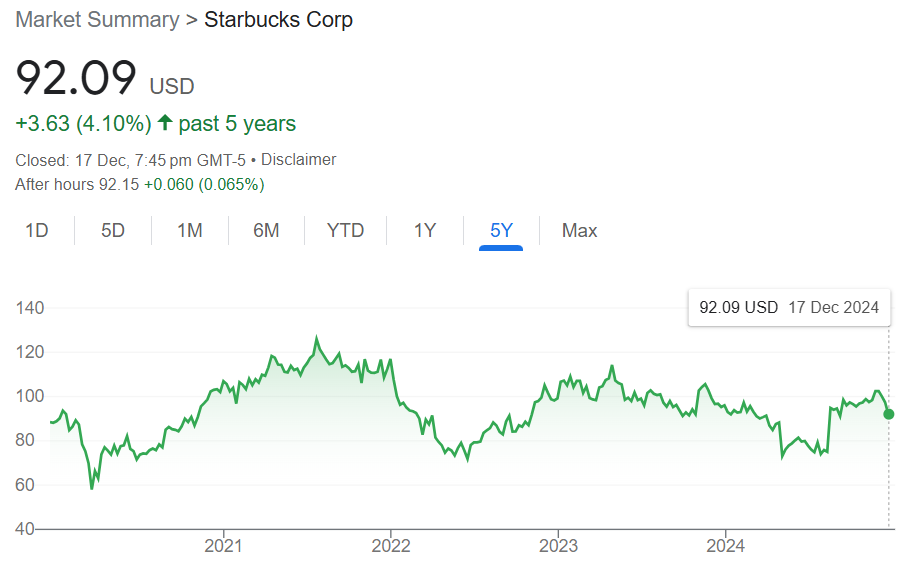
Starbucks share price (see below) seems to reflect this view – a downward trend starting in early 2023 went on for well over a year is now beginning to pick up, with Niccols at the helm. Here is my (potentially contrarian, likely underinformed) view on the issues at Starbucks and how these could be solved. Don’t miss the bonus piece on Starbucks in India – coming up soon.
(Subscribe to my blog on the home page and you will never miss a post. No advertising, no spam.)
© Priya Narayanan, Assistant Professor of Marketing, IIM Kozhikode. Views are personal.
*
All around Brian Niccols are people waiting and watching. And the last thing the newly anointed CEO of Starbucks probably wants is another bad set of quarterly financial results. But a few bad quarters might actually turn out to be good for Starbucks. Here’s why.
The new CEO’s statements make it clear that Starbucks intends to rediscover itself and deliver the same great experience to customers as it has always done. But the process of getting the Starbucks magic back is not going to be easy. The reason is that, at its core, Starbucks is a product company.
Leading with products
Despite being well-known as a textbook example of a services company, Starbucks knows its product much better than it knows its customers. For a long time now, customers have come for the products with their interesting names and customizations. And they have kept coming as Starbucks kept delivering newer and more interesting products. Innovation has been the winning mantra at Starbucks. (It helps that those who want the same daily morning cuppa also come to Starbucks.)
Not knowing the customer deeply and leading with products instead has placed Starbucks in a situation where operational efficiency takes centerstage. This approach would have worked well if Starbucks’s chosen business entailed minimal customer interaction, as would be the case with pure-play online order delivery, a drive-through takeaway service, or even a fast food dine-in restaurant. Instead, Starbucks prides itself on customer experience – be it the famous “third place” or the aroma of high grade coffee.
Understanding customers
In its early years through its heydays, Starbucks management (intuitively?) understood what good customer experience was. Something clicked between Starbucks and its customers, and these customers were many in number. Over the years, customers have changed. Newer, younger customers have come in as the business grew, and older customers’ needs have changed.
To now figure out again what the customer wants, considerable market understanding is needed, which is not what Starbucks in its inward-looking product-oriented stance is adept at. Having marketers on the leadership team, such as a Chief Brand Officer, could help. However, the current CBO is expected to be responsible for the brand, i.e., “marketing, product, digital, creative and data analytics,” according to news sources. Who, then, would be the customer advocate at Starbucks?
Redefining priorities
To “get back to what makes Starbucks, Starbucks” as Niccols promises, there is one thing the company needs to do. Starbucks needs to acknowledge that customers have changed and focus on truly understanding the new customer and their needs across geographies. This requires going back to the drawing board on segmentation and targeting, then tackling the needs of specific customer segments.
The company and the CEO need to engage in some soul-searching, which would result in prioritization and some uncomfortable tradeoffs. For instance, as a restaurant service that is (supposedly) all about customer experience will not find it easy to exclude mobile order delivery (which Starbucks has recently piloted in Mumbai.) The focus on customer experience is not driven so much by rewards points as by barista interaction, two things that work at cross purposes as they drive transactional repeat purchase vs. true brand loyalty, respectively.
This process of getting the Starbucks house in order would take time and the stock market might make its impatience known. However, if things are to really change at Starbucks, a few quarters might be needed. Otherwise, Starbucks will simply end up putting a Band-Aid over deeply entrenched issues. Which is why a few bad quarters followed by a rejuvenated stretch might be a good thing for Starbucks. Which could also be why Starbucks suspending its annual earnings forecast till September 2025 is not such a bad idea.
*
Bonus piece: What’s in store for Starbucks in India?
Read part two of this two-part analysis at Tata Starbucks: Of (Italian) glass size and (Indian) class size.
*
Subscribe to my blog on the home page and you will never miss a post. No advertising, no spam, no other emails.
 Marketing, Real and Ideal
Pingback: Tata Starbucks: Of (Italian) glass size and (Indian) class size | Marketing, Real and Ideal