© Priya Narayanan, Assistant Professor of Marketing, IIM Kozhikode. Views are personal.
This article describes my new elective course that focuses on how Technology has impacted Marketing practice, across four major dimensions: consumers, omnichannel marketing, martech, and marketing strategy. Besides discussing the use of caselets shared by two companies, the article lists a set of useful resources in this domain. Comments from participants of the course speak to its practical relevance and academic usefulness.
*
In May 2021, I decided to teach a PGP elective course The Digital Customer at IIMK. The idea was motivated by my sense – vague as it was – that the customer in the 2020s was no longer the customer of the 2010s when I did my MBA and PhD. We covered quite some ground, the students and I, but I was sure there was a lot more to my “sense” that things were changing rapidly.
I then offered a different elective Marketing to the Digital Customer in 2022, which, in hindsight, was even less satisfying in its ability to capture the goings-on in the market and in the field of marketing. Students probably guessed this, because the course found no takers.
In 2023, after much rework, the course reappeared to PGPs as Marketing Strategy for the Digital World. This course resonated with Executive PGP students, and with PGP students in 2024, as some of the course alumni who might be reading this post might agree. If you do, pls share in the comments!
But marketing strategy for the digital world was, after all, what every company was doing: adding a digital flavor to everything marketing. So what remained besides regular Marketing? What was it that was worth learning about from a student’s or manager’s point of view?
To me the answer was closer to a “reinvention” of marketing. That too, very likely a bottom-up reinvention, because technology had begun to touch each element of marketing and transform many of those. Marketing as traditionally understood and taught through the standard b-school perspective needed a relook. It was a bold and semi-substantiated view to take, but bottom-up changes necessitate top-down evolution in strategy. This, for sure, was worth studying!
And so, the course Marketing Meets Technology came into being. This is what Marketing had been doing for the last decade! I first wrote about the course on my blog in June last year as the course started taking shape. The very first innings of the course with over 80 participants from the executive MBA program was wrapped up late last month. The course consists of four modules:
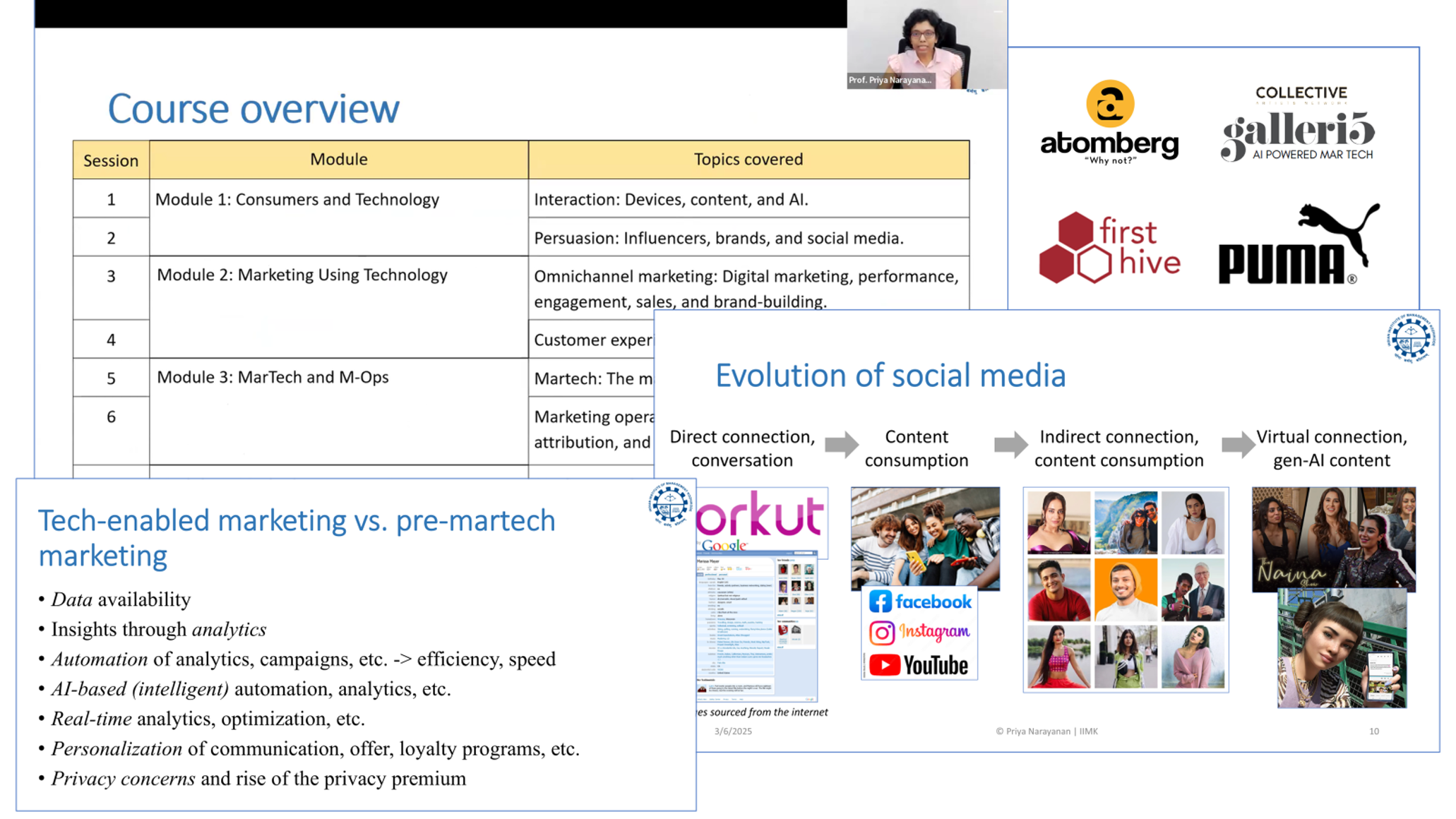
- Consumers and technology: consumer psychology and behavior in the context of omnipresent devices and technology
- Marketing using technology: modern omnichannel marketing with technology-driven synergy that goes well beyond presence on multiple channels
- Martech (marketing technology) and M-ops (marketing operations): intelligent, real-time, and automated campaign optimization, analytics, attribution, and others
- Marketing strategy meets technology: all of the above come together in creating marketing as we (should) understand it today, and this informs CMOs and marketing heads
The most interesting aspect of the course is the input from marketing practice, in terms of both method and content. For this course, I attempted to move beyond the classic case method to using caselets graciously shared by companies working at the cutting edge of marketing and technology. We did learn using published cases, but for a course that aims to explore the very latest at the intersection of marketing and technology, I figured (and correctly, in hindsight) that students would benefit from recent real-life caselets.
Rahul Regulapati, Founder and CEO of Galleri5, part of Collective Artists Network, shared caselets related to work on mapping social intelligence trends on a social media platform as well as on AI-generated lifestyle imagery for an apparel brand’s e-commerce portal. When students commented that the genAI images looked really “real,” we laughed over the fact that this was an apparel platform and not Tinder! We wondered about the future of human models vs. AI models, but clearly AI imagery is here to stay given its low cost and high speed. Interesting times on the horizon for marketers.
Aditya Bhamidipaty, CEO and Founder, and Namrata Suryavanshi, Director of Consulting and Customer Experience, FirstHive, a Customer Data Platform – a major element among various types of companies that constitute the martech (marketing technology) landscape – provided caselets on how two companies in different industries realized real business value by unifying first-party customer data obtained from various channels to create unique customer identities. These identities were then used to provide personalized, contextual, and real-time triggers to enable more successful conversions.
The hot-off-the-oven caselets from galleri5 and FirstHive demonstrate how marketing and technology have come together (technology folks probably think they have the upper hand!) to create emerging areas for marketers, in both customer-facing and internal functions.
Besides engaging students with caselets, I managed to persuade Aditya (who was keen on taking the session too!) to interact with the participants of the course through a guest session. The session focused on ‘Martech and Marketing Strategy’ and turned out to be a roaring hit, given Aditya’s expertise in the domain, his style of conducting the session, the interest in martech among participants, and a paucity of sources that provide clear understanding with respect to this rapidly growing area.
In the age of data privacy concerns mingled with consumers’ need for personalization and marketers’ ability to personalize, martech has a very important role to play as it handles, streamlines, and guards customer data. The industry note ‘Developing a Marketing Technology Blueprint’ by Professor Kimberley A. Whitler at UVA Darden and Scott A. Vaughan, long-time CMO and GTM consultant provided a base for students’ understanding of martech. Some other key resources include:
- The Martech content platform by Semrush at https://martech.org/
- Scott Brinker’s blog at https://chiefmartec.com/
- The daily newsletter from American Marketing Academy, at https://www.ama.org/our-marketing-newsletter-my-ama-daily/
*
In sum, this was one course which truly exceeded expectations! The learning experience was thoroughly co-created by participants who asked interesting questions and shared relevant experiences. Participants who talked about robotic integration, chatbot services, AI in creative design, innovation at the “AI hub” of an MNC, and several others. As usual, we laughed, learnt, and lived our Sunday afternoons and Monday evenings with each other.
Here is what students had to say on the course, the caselets, and the guest session:
- The caselet pedagogy was very much appropriate and provided ample learning.
- Caselets were really good to understand Martech and relevant ideas.
- Bringing Industry expert was really good, it helped me understand the subject.
- Caselets and live discussions in the class are quite effective, useful, and engaging. This is the right model for learning.
- A lot of brainstorming helped to identify things differently.
- The course was really helpful, including the guest lecture.
- The caselet pedagogy encourages critical thinking and real-time application of concepts.
- Requires spontaneous thinking and hence increases the level of alertness in class.
- Encouraged critical thinking and application.
The plan now is to compile other relevant caselets in the MMT (Marketing Meets Technology) space and share this (with appropriate caveats on usage and reproduction) to the academics and students. If you are a manager or marketing head with experiences you would like to share, pls reach out to me. Find me on LinkedIn here and find my academic contact details here.
*
 Marketing, Real and Ideal