Take Two: The Future of the Two-Year Full-Time MBA in India

© Priya Narayanan, Assistant Professor of Marketing, IIM Kozhikode. Views are personal.

This article was first published online on December 13, 2024 as a special feature in the IIM Ahmedabad alumni magazine WIMWIAN and is available here on IIMA’s website for the magazine. Note: I hold an MBA (the two-year full-time kind!) and a PhD, both from IIM Ahmedabad. The programs that I teach at IIM Kozhikode are listed at the end of the article.

*

Recent months have witnessed an emerging debate on the relevance of the two-year full-time MBA programmes across B-schools in India. With the rise in online and hybrid programmes boosted by the pandemic, and prospective students reconsidering spending two full years on academics, the flagship postgraduate programme at IIMs and other B-schools is under scrutiny.

To understand the issue, it is important to note that IIMs, especially the older IIMs, had historically been endowed with the mandate of training managers for the country. These institutes did so through rigorous academic programmes spanning a vast curriculum traversed over two years, and churned out general managers who could hold their own in any field.

The evolving MBA

Over the years, many things have changed but many things have held steady. Demand for the two-year full-time MBA (referred to as PGP, using legacy terminology) continues unabated: the most recent 2023 edition of the Common Admission Test (CAT) that originally provided admission to the IIMs but is now adopted by several other B-schools was written by 2.88 lakh candidates, an increase of 30% over the previous year. Clearly, the numbers attest to the popularity of the PGP.

Continue reading
Tata Starbucks: Of (Italian) Glass Size and (Indian) Class Size

How does the size of the serving glass (minimum 240 ml) and the size of India’s urban middle class (88% of the population) matter to Starbucks India? Let’s find out, in this second of two articles on Starbucks.

© Priya Narayanan, Assistant Professor of Marketing, IIM Kozhikode. Views are personal.

*

As part one of my two-part analysis of Starbucks (posted about a week ago) suggests, Starbucks globally seems to be in the kind of trouble that takes time to pass. However, closer home, things seem less stark. Tata Starbucks has two big factors going for it: advantage Tata that continues to give, and a growing market that is any MNC’s dream. But is that enough?

Before answering this, let’s address a niggling but real issue with Starbucks in India.

A Starbucks store in India. Source: internet.
Continue reading

Why a Few Bad Quarters Might be Good for Starbucks

Starbucks was in the blazing limelight a month or so ago. This time the news was not a new product launch or a new store opening, but the ways that the new CEO Brian Niccols (replacing the incumbent Laxman Narasimhan before his term ended) intended to “make Starbucks, Starbucks again”. In his “open letter for all partners, customers and stakeholders”, Niccols acknowledged that Starbucks seemed to “have drifted from [its] core.”

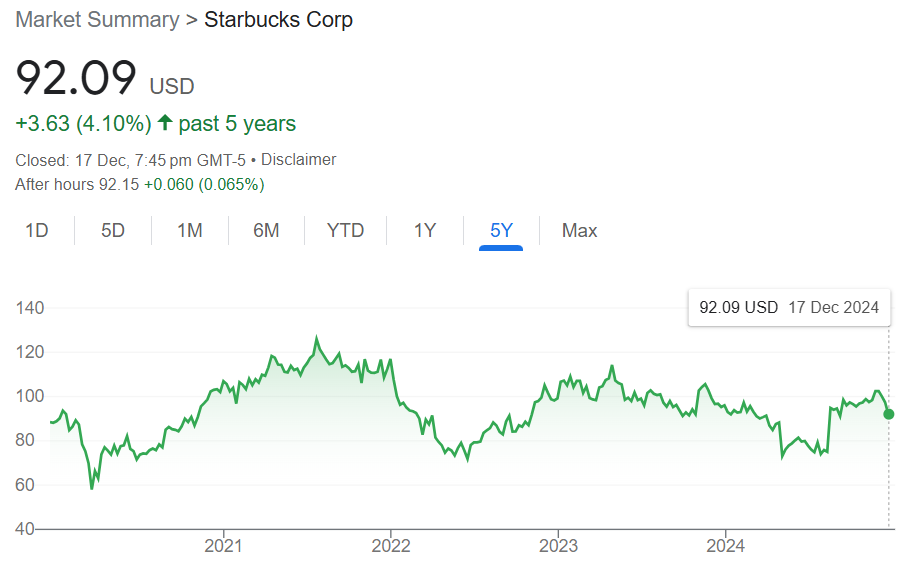
Starbucks share price (see below) seems to reflect this view – a downward trend starting in early 2023 went on for well over a year is now beginning to pick up, with Niccols at the helm. Here is my (potentially contrarian, likely underinformed) view on the issues at Starbucks and how these could be solved. Don’t miss the bonus piece on Starbucks in India – coming up soon.

(Subscribe to my blog on the home page and you will never miss a post. No advertising, no spam.)

Share price trend of Starbucks, 2020-2024. Source: Google search.

© Priya Narayanan, Assistant Professor of Marketing, IIM Kozhikode. Views are personal.

*

All around Brian Niccols are people waiting and watching. And the last thing the newly anointed CEO of Starbucks probably wants is another bad set of quarterly financial results. But a few bad quarters might actually turn out to be good for Starbucks. Here’s why.

Continue reading

Just What I Like: What Brands can Learn from Ronaldo’s Snub of Coca Cola

© Priya Narayanan, Assistant Professor of Marketing, IIM Kozhikode. Views are personal.

It was during the final match of FIFA football World Cup in 2006 that Zinedane Zidane, the French football legend, head butted a player from the opposing team and watched from the benches as a penalty kick saved the day for Italy (watch the video here). After all these years, Ronaldo’s snub of Coca Cola is possibly the nearest I have seen to Zidane’s act in terms of wilfulness.

While many might disagree, the point remains that a statement was made at the last month UEFA pre match press conference. Avoid Coca Cola, drink water. A point well made indeed, as can be seen in this video that soon became viral. Apparently, Coca Cola lost $4 billion in stock value that day for this reason. (This Forbes article, though, presents an interesting counter view.) Regardless of monetary losses, customers might have started to think.

A celebrity sportsperson blatantly deriding the leading fizzy drink of the world! Could this be the end of sugar and fizz? Then again, one could argue that those who drink Coca Cola will continue to do so, some might take pride in their unwise loyalty to the drink. But, right now, the anti-Coca Cola sentiment that has dogged the brand like an unwelcome guest seems to have found form. Till memory fades, the Ronaldo incident can be used to present a silent but clear visual sword-shake at the brand.

Continue reading

The Ferrari Formula: A Ferrari in Every Home. Really?

© Priya Narayanan, Assistant Professor of Marketing, IIM Kozhikode. Views are personal.

From a well-known brand of racing cars to a fashion brand label, Ferrari has come a long way. Yes, you read that right, Ferrari is now selling in-house fashion apparel. Here’s a video of the models on the ramp, oops, on the Ferrari production line. Are we witnessing the democratization of luxury, or is this just another unimaginative attempt to milk the market?

So, Ferrari seems to say: If you can’t buy the car, you can buy the jacket. Or at least a cap. But then you could always buy Ferrari merchandise earlier through franchisees. These branded products have been used in product placements as well. (A hilarious scene in the Bollywood movie Munna Bhai MBBS shows taporis whisking off a tourist – wearing a Ferrari red cap – to supply a personal cadaver for Munna Bhai, the doctor-to-be, to tear apart and learn.)

Continue reading

Fighting Covid-19 with Corporate Nudges: Time for Businesses and Governments to Join Hands?

© Priya Narayanan, Assistant Professor of Marketing, IIM Kozhikode. Views are personal.

Recently, Krispy Kreme came into the limelight for offering a free glazed donut to anyone in the US who could show a covid vaccination record card. Other companies have also started offering freebies for vaccinations. What’s going on? Why should a donut company care whether people get themselves vaccinated? After all, conventional wisdom tells us that it’s the duty of the government and not private companies to ensure public health.

Indeed, Krispy Kreme has faced criticism for its initiative, because it is offering an unhealthy snack in the interest of driving a public health measure. But what else can a donut company do, especially when it is simply offering a reward for good behavior? As every parent would vouch, rewards are an essential nudge towards desirable actions. In any case, offering something tangible in support of the vaccination effort does seem to be better than capitalizing on the covid situation through messaging in the form of unproductive lip service as this Horlicks ad purports to do. Just as this Dabur ad once did by (insensitively?) showcasing loss of hair caused by cancer.

Continue reading

The Digital Customer: Differences from the Traditional Customer and Implications for Businesses

© Priya Narayanan, Assistant Professor of Marketing, IIM Kozhikode. Views are personal.

Teaching in a virtual classroom over the past few months has made me think about how the thoughts and actions of digital customers are different from what marketers have traditionally thought of as customer behavior. The pandemic has accelerated the change by getting people to engage in activities that they carried out either infrequently or probably never, be it online shopping, online banking, working at home, or even using a laptop. This article is an attempt to examine how today’s digital customer differs from the traditional customer, and the implications that this holds for businesses. The views presented here are based on my observations and do not claim to be comprehensive.

First, the digital customer is often, but not always, characterized by behaviors that digital technology allows for. The most common behavior is that of easy switching between activities, which was first evident when the television remote came into the market. Switching occurs because consumers want variety, can easily move between windows, and there are lots of activities competing for their attention – motivation, ability, and opportunity, as consumer research would call it.

Continue reading

Why Virtual Should Continue Even After it’s Not Needed. At Least in Academic Conferences

© Priya Narayanan, Assistant Professor of Marketing, IIM Kozhikode. Views are personal.

Recently I participated in the Association for Consumer Research (ACR) annual conference 2020 as a presenter. The ACR conference is a large and prestigious academic conference on research related to consumer behavior. The conference was held virtually in Paris. Participating virtually meant that one could not get the “feel” of a typical conference (which I will call a “venue” conference going forward). But it struck me that once I let go of my expectations of a venue conference, the virtual format was probably – no, definitely – more effective, at least for me. The virtual conference starkly revealed how costly venue conferences had been, when I counted the nonobvious costs of venue compared to virtual.

In this write-up, I have attempted to explain why, and hence make a case for all conferences considering going partially virtual even after the pandemic lifts. Towards the end I have given a set of options that conference organizers can consider when the pandemic has been managed and virtual conferences are no longer essential.

Note: this post is long, but is structured with numbered and titled lists for easier reading.

Continue reading

Google Duo’s New Campaign in India – To What Purpose?

© Priya Narayanan, Assistant Professor of Marketing, IIM Kozhikode. Views are personal.

Saw an ad for Google Duo the other day, and this one is worth talking about. But probably not worth much more.

It shows the freshest couple in town – who else but actor Anushka Sharma and cricketer Virat Kohli! – at their admirable best. Even earlier, every young couple had wanted to be like them: rich, famous, good looking, and young forever. Now, in this video ad available on YouTube, we see the camaraderie between them as Anushka plays a prank on Virat.

Agreed, the laughing wife and the trusting-but-fooled husband are quite adorable. However, in a video calling market increasingly captured by Whatsapp – everyone uses Whatsapp messaging, and its video calling is seamless with messaging – it is not clear how developing a celebrity-based liking for its brand will help Duo.

Continue reading

The Changing Actors of Indian Television Advertising [Prize Winner]

This article was first published as a prize-winning entry in the Dec 2018 edition of the campus newsletter on marketing, Niche (Niche on Facebook here and on Twitter @iimaniche). I have added YouTube links to some old ads.

*

Some of the earliest Indian television ads have been by the soap brand Lifebuoy. Our parents, if not we, would recall how Lifebuoy entered the market as a long red bar of carbolic soap, often cut into two halves before being used, for that was an age of patent frugality. The bathing experience, with a bucket and mug, was not very similar to the shower in the tandurusti ad, but there you have it: advertising is more aspirational than realistic. How, then, has such advertising portrayed its actors?

First, the children. Who can forget the adorable girl and her sweet way of saying, “I love you, Rasna”? While Rasna might now be passé, the idea of presenting children in advertising, targeting either parents or children or both, is an incredibly winning strategy. Remember the boy beating up a puddle on the road in the Surf excel daag acche hai campaign? As all seasoned advertisers know (and many others suspect), the road to a mother’s heart (and her purse) lies through children.

Click here to continue reading.