How to leverage India’s MarTech boom [Forbes India]

(c) Namrata Suryavanshi, Priya Narayanan, and Aditya Bhamidipaty

This article was first published online on May 23, 2025 in The Forbes India (online) IIM Kozhikode Thought Leadership section and is available here on the publisher’s website. The article below provides an updated version of the infographic from Scott Brinker’s Marketing Technology landscape.

Namrata is Director – Consulting & Customer Experience at FirstHive, a Customer Data Platform. Priya is Assistant Professor of Marketing at IIM Kozhikode. Aditya is Founder & CEO at FirstHive.

*

Imagine this: you’ve just landed in Barcelona after a gruelling 24-hour flight. You’re exhausted, and all you want is to check into your hotel and rest for a while in those soft new fancy pyjamas you bought for this trip. But then, reality hits—you realise your baggage hasn’t arrived. Panicked, you rush to the airline authorities, and they assure you that your luggage will be delivered to your hotel… in two days. Frustrated, you turn to social media, venting your anger and tagging the airline. Within seconds, you receive a response. But instead of empathy, you’re greeted with the last two words you want to see right now. Any guesses? “Thank you for sharing your feedback.”

Now, your frustration multiplies. The airline seems robotic and indifferent—completely out of touch with your situation. You might even vow never to fly with them again. So, what went wrong here? The airline relied on automated technology to send an instant response, but the message lacked context, empathy, and personalisation.

Could the airline have used smarter technologies to gauge your frustration and tailor a response using generative AI? Absolutely. And that’s exactly what we’ll explore in this article—how marketers, particularly in India, are adapting to MarTech. We delve into the unique challenges Indian marketers face, especially when bridging gaps arising from multiple cultures, languages, and geographies, and how technology can be a game-changer in delivering personalised, contextually relevant experiences.

Continue reading
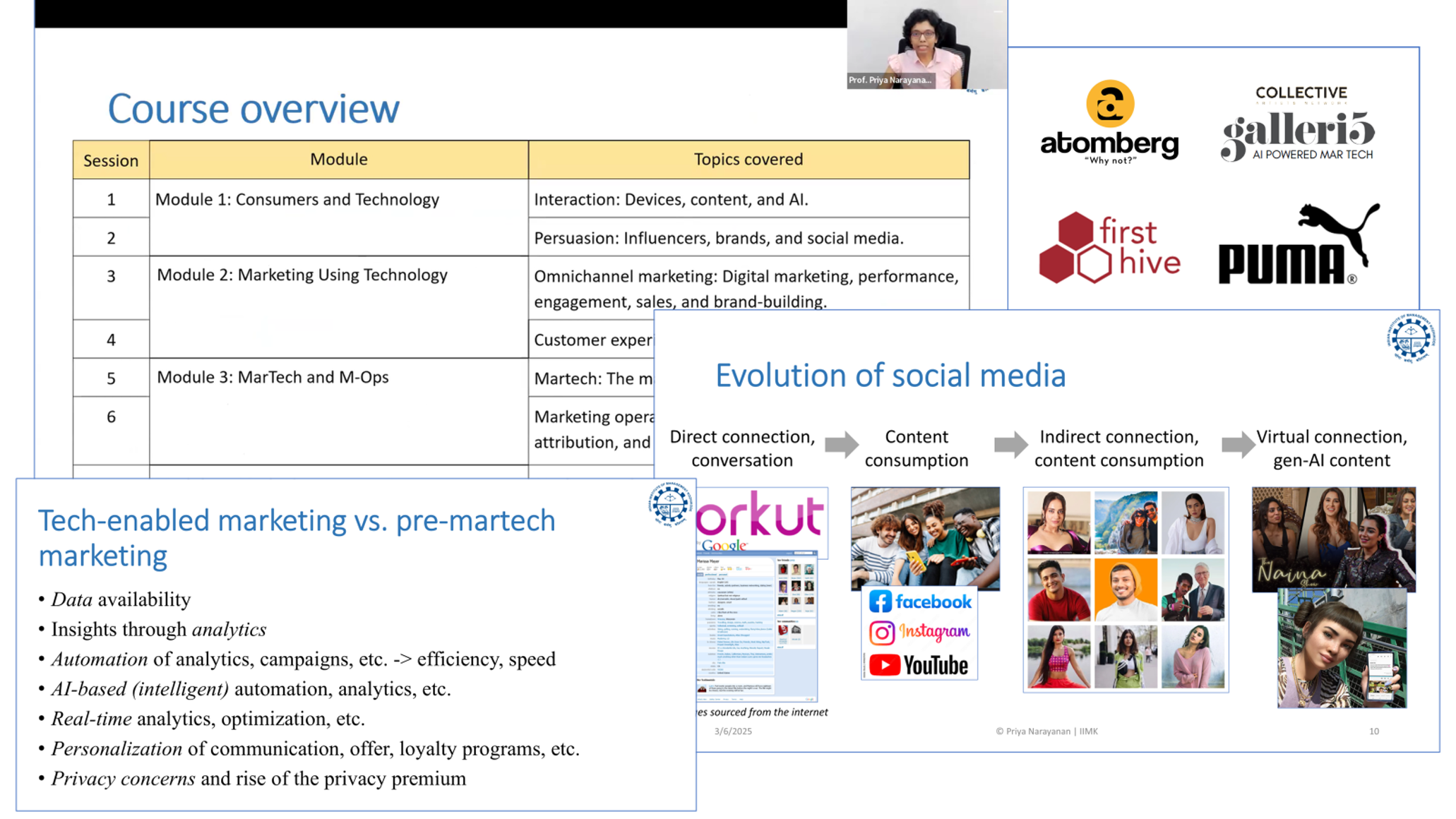
Marketing Meets Technology – Bringing Marketing Practice to Academics

© Priya Narayanan, Assistant Professor of Marketing, IIM Kozhikode. Views are personal.

This article describes my new elective course that focuses on how Technology has impacted Marketing practice, across four major dimensions: consumers, omnichannel marketing, martech, and marketing strategy. Besides discussing the use of caselets shared by two companies, the article lists a set of useful resources in this domain. Comments from participants of the course speak to its practical relevance and academic usefulness.

*

In May 2021, I decided to teach a PGP elective course The Digital Customer at IIMK. The idea was motivated by my sense – vague as it was – that the customer in the 2020s was no longer the customer of the 2010s when I did my MBA and PhD. We covered quite some ground, the students and I, but I was sure there was a lot more to my “sense” that things were changing rapidly.

I then offered a different elective Marketing to the Digital Customer in 2022, which, in hindsight, was even less satisfying in its ability to capture the goings-on in the market and in the field of marketing. Students probably guessed this, because the course found no takers.

In 2023, after much rework, the course reappeared to PGPs as Marketing Strategy for the Digital World. This course resonated with Executive PGP students, and with PGP students in 2024, as some of the course alumni who might be reading this post might agree. If you do, pls share in the comments!

But marketing strategy for the digital world was, after all, what every company was doing: adding a digital flavor to everything marketing. So what remained besides regular Marketing? What was it that was worth learning about from a student’s or manager’s point of view?

To me the answer was closer to a “reinvention” of marketing. That too, very likely a bottom-up reinvention, because technology had begun to touch each element of marketing and transform many of those. Marketing as traditionally understood and taught through the standard b-school perspective needed a relook. It was a bold and semi-substantiated view to take, but bottom-up changes necessitate top-down evolution in strategy. This, for sure, was worth studying!

And so, the course Marketing Meets Technology came into being. This is what Marketing had been doing for the last decade! I first wrote about the course on my blog in June last year as the course started taking shape. The very first innings of the course with over 80 participants from the executive MBA program was wrapped up late last month. The course consists of four modules:

What we covered in the first innings of Marketing Meets Technology
Continue reading

“India’s social network” is tea. The question is, which tea?!

First published July 2, 2023. Updated Oct 31, 2023 with a) an edited version of the ad shared by Red Label (following my article?!), and b) link to relevant research article.

© Priya Narayanan, Assistant Professor of Marketing, IIM Kozhikode. Views are personal.

A recent advertisement projects the humble tea as “India’s social network”. The ad is probably trending by this time, and worth at least one watch. The customer insight is spot-on. The video portrays various ways in which tea takes the form of friend requests, likes, shares, trends, stories, and so on in India, becoming a social network in itself. Engrossed as we are in the narrative, we forget that this is a brand’s commercial. Finally, though, the very last shot tells us that the ad is from Brooke Bond Red Label.

Screen shot from the “India’s social network” ad (watch the full ad here)

Well, as I watched the ad play, my thoughts centred on the cup of Kanan Devan (Tata Tea) tea that I usually drink in the morning and evening… steaming tea in a steel tumbler… the quantity never enough but I never make more… I am happiest when that tea is fully foamy at the top… and when I blow on it a teeny bit, the foam makes space for the beautiful brown color beneath… if the color is the right shade, the tea will be the right taste… oh yes, the tea packet at home is nearly finished and I need to buy another of the green packets soon…

Continue reading

Learning Marketing from Shelby Hunt – A Tribute

(c) Priya Narayanan, Assistant Professor of Marketing, Indian Institute of Management Kozhikode

Caution: this article is on academic research. If that isn’t your cup of tea, you could read my recent popular article on The CMO’s Playbook instead.

Context of this article

About three months ago, reading (again) Shelby Hunt’s “The nature and scope of marketing”, I decided to write to Prof. Hunt, not with any particular research question or objective, but to interact once with the great mind that could, in one sweeping paragraph, summarize all of marketing till then:

“During the past three decades, two controversies have overshadowed all others in the marketing literature. The first is the “Is marketing a science?” controversy sparked by an early JOURNAL OF MARKETING article by Converse entitled “The Development of a Science of Marketing.” Other prominent writers who fueled the debate included Bartels, Hutchinson, Baumol, Buzzell, Taylor, and Halbert. After raging throughout most of the ’50s and ’60s, the controversy has since waned. The waning may be more apparent than real, however, because many of the substantive issues underlying the marketing science controversy overlap with the more recent “nature of marketing” (broadening the concept of marketing) debate. Fundamental to both controversies are some radically different perspectives on the essential characteristics of both marketing and science.” (Hunt 1976, p. 17, emphasis added)

Reading this the first time, towards the end of the second year of my PhD, I was not impressed. But, having read and written and thought and analysed much, I start to sense in Hunt’s writing a comprehensiveness, clarity, and directness that was not visible to me earlier. To learn that the author of this writing is no longer with us and that the meeting I considered requesting (I even wondered which email address would Prof. Hunt be reachable at, since he had recently retired from his long-standing faculty position), left me with a sense of loss that I did not anticipate. This article is an attempt to understand why.

Continue reading

Me e Mia: An Introspection into Brand Love

Part I: The Customer’s Perspective

© Priya Narayanan, Assistant Professor at IIM Kozhikode. Views are personal.

The other day, I shared a thought on LinkedIn on the Mothers’ Day video of a jewelry brand. Mine wasn’t a well thought out analysis, it was simply a spontaneous reaction to the content of the video. Writing the post, however, made me wonder: why did I care so much? Why was I so strongly unhappy with the ad? (The tone implied in “golden shoulders” surprises me now!)

Well, eight years ago, I wrote about this very same brand, on wearing the Tanishq Mia mantle of confidence.

Rereading that led to some introspection, which then led to the conclusion: I am in love. Yes, I don’t wear much gold jewelry but I love the brand that is Tanishq. Naturally, I felt the possessive anger that only love can lead to when Tanishq made a statement I didn’t feel good about or agree with. So says the marketer in me about the consumer in me. Me e mia. Me and mine. Me and my brand.

Continue reading

Potential Customer, or Buyer? A ‘Hand-Raise’ Cannot Tell You

© Priya Narayanan, Assistant Professor of Marketing, IIM Kozhikode. Views are personal.

Remember that time you went to buy clothes – you casually touch or look at a dress and the salesperson starts following you? From that point on, you are pressed with clothing suggestions, hand-guided to the trial room, and complimented as you try something on, all the way till you step into the payment queue. (Wonder how this works at an AmazonGo store.) And all you wanted was to “look” at a few clothes! And if you really liked something, you would pick it up. If you needed help, you would ask. (Of course, I could be exaggerating, it has been years since many of us went on a shopping trip just for fun. Hopefully, not any more.)

Apparently, by touching or looking at a dress (before the inconspicuous salesperson’s eagle eyes), you have engaged in a “hand-raiser” – you have shown interest in buying. But this is where a huge sea of miscommunication separates the customer and the company/salesperson. The customer, by their own definition, is a “potential” customer and just wants to look. The customer, according to the company, wants to buy and would like to be helpfully nudged till purchase. Clearly, this does not make for an easy customer relationship!

Continue reading

Digital Customer or Digital Marketing?

© Priya Narayanan, Assistant Professor of Marketing, IIM Kozhikode. Views are personal.

SEO, influencer marketing, content marketing, social media strategy… these are some of the terms that exemplify popular views of digital marketing. But when trying to comprehend digital marketing, two problems arise: What exactly is “digital” in digital marketing? And does digital marketing include anything beyond digital communication?

In this article, I attempt to answer these questions based on my experience in marketing and digital marketing, experience gained through learning, teaching, and consulting. I also include definitions by researchers and the American Marketing Association, and offer a book suggestion for those interested in learning more.

Continue reading

Just What I Like: What Brands can Learn from Ronaldo’s Snub of Coca Cola

© Priya Narayanan, Assistant Professor of Marketing, IIM Kozhikode. Views are personal.

It was during the final match of FIFA football World Cup in 2006 that Zinedane Zidane, the French football legend, head butted a player from the opposing team and watched from the benches as a penalty kick saved the day for Italy (watch the video here). After all these years, Ronaldo’s snub of Coca Cola is possibly the nearest I have seen to Zidane’s act in terms of wilfulness.

While many might disagree, the point remains that a statement was made at the last month UEFA pre match press conference. Avoid Coca Cola, drink water. A point well made indeed, as can be seen in this video that soon became viral. Apparently, Coca Cola lost $4 billion in stock value that day for this reason. (This Forbes article, though, presents an interesting counter view.) Regardless of monetary losses, customers might have started to think.

A celebrity sportsperson blatantly deriding the leading fizzy drink of the world! Could this be the end of sugar and fizz? Then again, one could argue that those who drink Coca Cola will continue to do so, some might take pride in their unwise loyalty to the drink. But, right now, the anti-Coca Cola sentiment that has dogged the brand like an unwelcome guest seems to have found form. Till memory fades, the Ronaldo incident can be used to present a silent but clear visual sword-shake at the brand.

Continue reading

The Ferrari Formula: A Ferrari in Every Home. Really?

© Priya Narayanan, Assistant Professor of Marketing, IIM Kozhikode. Views are personal.

From a well-known brand of racing cars to a fashion brand label, Ferrari has come a long way. Yes, you read that right, Ferrari is now selling in-house fashion apparel. Here’s a video of the models on the ramp, oops, on the Ferrari production line. Are we witnessing the democratization of luxury, or is this just another unimaginative attempt to milk the market?

So, Ferrari seems to say: If you can’t buy the car, you can buy the jacket. Or at least a cap. But then you could always buy Ferrari merchandise earlier through franchisees. These branded products have been used in product placements as well. (A hilarious scene in the Bollywood movie Munna Bhai MBBS shows taporis whisking off a tourist – wearing a Ferrari red cap – to supply a personal cadaver for Munna Bhai, the doctor-to-be, to tear apart and learn.)

Continue reading

Fighting Covid-19 with Corporate Nudges: Time for Businesses and Governments to Join Hands?

© Priya Narayanan, Assistant Professor of Marketing, IIM Kozhikode. Views are personal.

Recently, Krispy Kreme came into the limelight for offering a free glazed donut to anyone in the US who could show a covid vaccination record card. Other companies have also started offering freebies for vaccinations. What’s going on? Why should a donut company care whether people get themselves vaccinated? After all, conventional wisdom tells us that it’s the duty of the government and not private companies to ensure public health.

Indeed, Krispy Kreme has faced criticism for its initiative, because it is offering an unhealthy snack in the interest of driving a public health measure. But what else can a donut company do, especially when it is simply offering a reward for good behavior? As every parent would vouch, rewards are an essential nudge towards desirable actions. In any case, offering something tangible in support of the vaccination effort does seem to be better than capitalizing on the covid situation through messaging in the form of unproductive lip service as this Horlicks ad purports to do. Just as this Dabur ad once did by (insensitively?) showcasing loss of hair caused by cancer.

Continue reading