The Mobile-Free Classroom – A Dream Come True

© Priya Narayanan, Assistant Professor of Marketing, IIM Kozhikode. Views are personal.

This article was first published on LinkedIn and is available here.

Don’t get me wrong, I don’t have anything against mobile phones (just an allergy, as my students know).

But I recently had a dream-like experience of teaching a class where students did not have mobile phones anywhere near them. Dream-like, because the mobile phone is every student’s partner-in-crime during classes. So much so that sometimes I miss students who engage in good old doodling or hangman.

These students had deposited their phones in a basket (they did not have a choice) and let themselves into the uncharted territory of sitting in class without the “adult pacifier” at hand (see image, research by Shiri Melumad and Michel Tuan Pham). Not even laptops or tablets. The credit for the mobile-free class goes to the HR manager. I spoke with Pradnya for just two minutes, but her willpower was evident, and her good intentions were obvious.
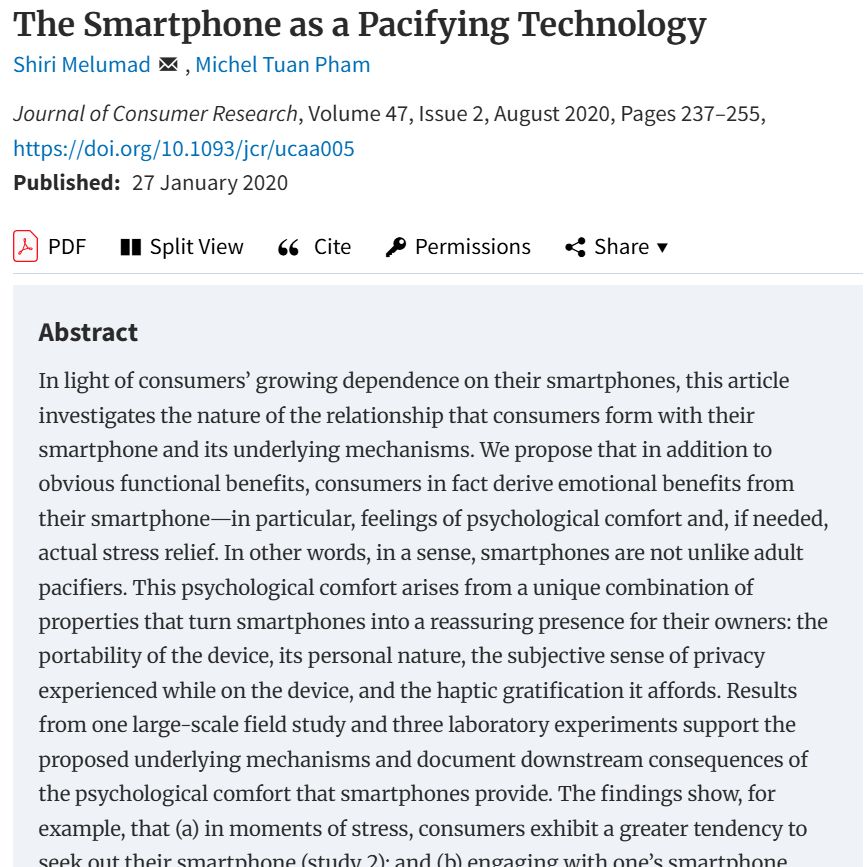
Source: https://academic.oup.com/jcr/article/47/2/237/5716332


And so, I taught my first ever classroom where mobile phones were absolutely absent. Not just invisible or inaudible, but really absent from the minds of the students.

When the mobile phone is present, it has a pull, it is just waiting to be checked, and can’t be denied. So even if a student decides not to use the phone, but the phone is on the desk or even in the bag, the silent call of the phone continues to distract (see image, research by Adrian Ward, Kristen Duke, Ayelet Gneezy and Maarten Bos). In the mobile-free class, there is no such distraction.
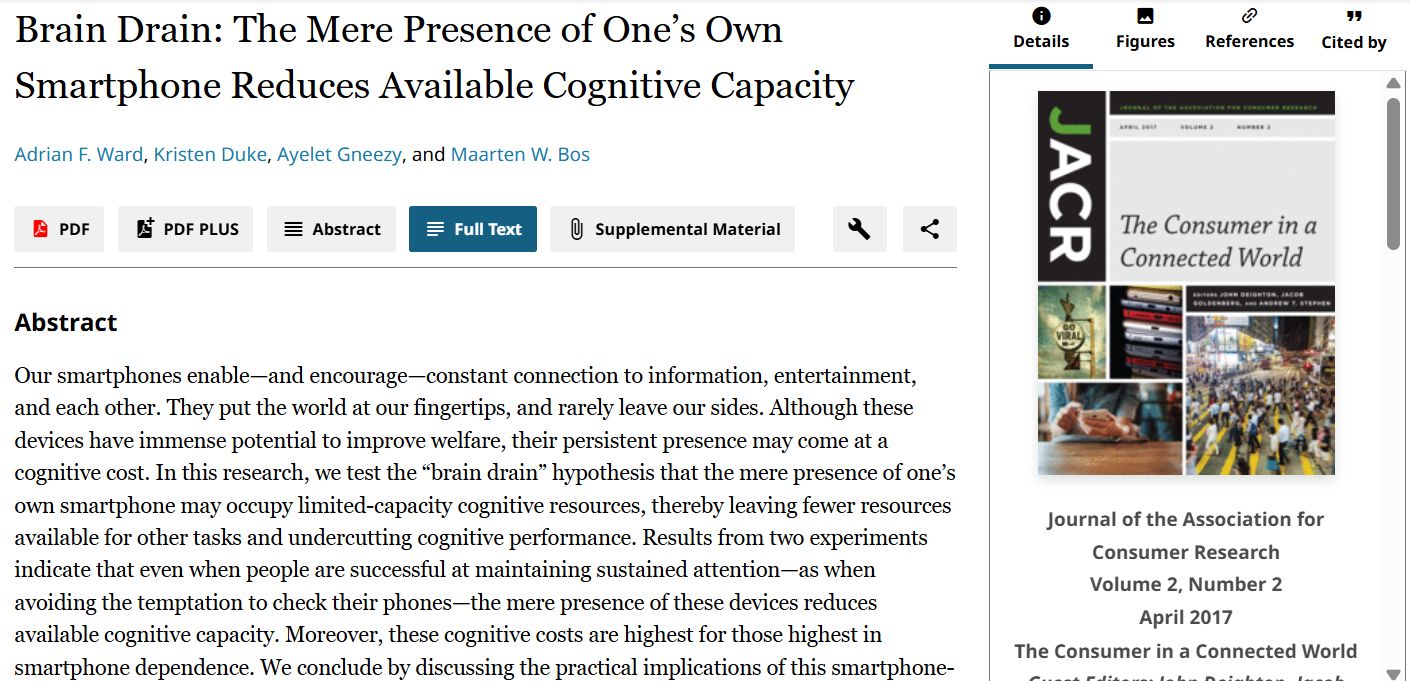

Source: https://www.journals.uchicago.edu/doi/abs/10.1086/691462


Now, I do not yet have proof, but as someone who has taught graduate students and executives for about 800 hours, low distraction classes (classes where students oblige with my request to put their phones away) operate at a higher plane of engagement and learning compared to high distraction classes. The absence of electronic devices activates the one device which will accompany us through life, even in the age of AI – the brain!

Students often don’t get an opportunity to notice the benefits of a mobile-free class, and this creates an understandable resistance to putting away the phone. But objective research and my experience concur on this observation. And every year there are a few students who thank me (Aparna D in The CMO’s Playbook was the first!) for requesting that they avoid using the phone. And that’s where the proof of the pudding lies… in switching off the phone and letting the class take you places.

So next time your teacher requests the class to put away your phones, do so with a smile. It’s one small step for a student, one giant leap for education!

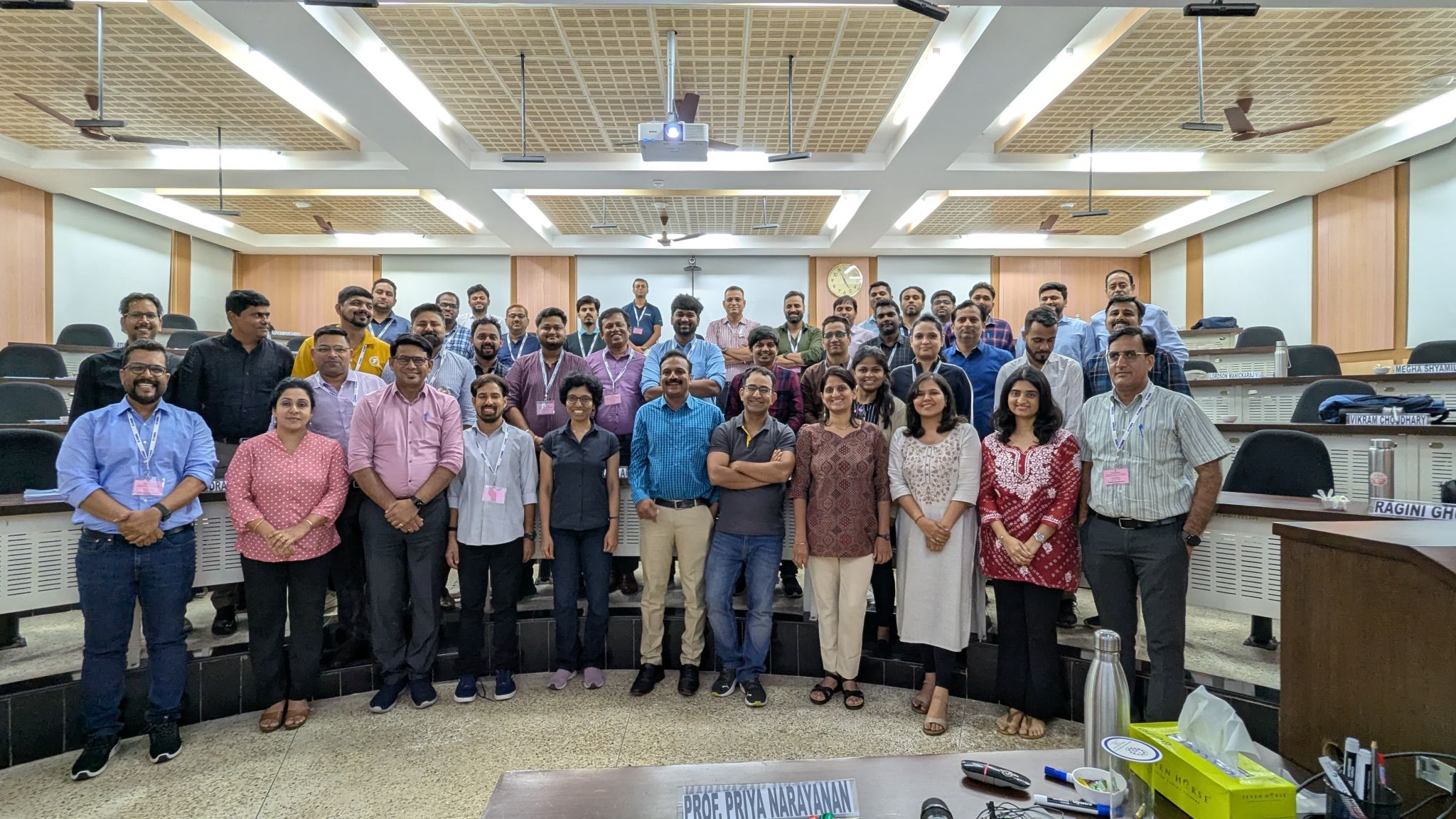
Here’s all of us after six hours of refreshing freedom!
*
The 10 best Marketing cases I have ever taught

As the new academic year rises on the horizon, I thought about the cases (in Marketing) that I have taught in past few years and listed the top ten. My best teaching experiences – taking into account the best learning experiences of my students – took place while teaching these cases.

The list is slightly inclined towards marketing strategy, and does not include the good old work-your-way-through-it numerical analysis cases as these are required but do become somewhat boring at times. I have listed only the interesting cases, which really connect with students and sometimes even divide the class!

Most of these cases can be taught across programs and years (perhaps a few are not suitable for the first-year basic marketing course, and many are unsuitable for undergraduate courses) with a little flexibility, creativity, and improvisation from the faculty. Then again, you can’t have a course of just these cases – these are best consumed as the laddus in a diet that otherwise consists of good old dal-chawal-roti-subzi, in my view.

Continue reading

The CMO’s Playbook – This Year’s Collage

Whenever the small-group discussions in the classroom get noisy, it means one of two things: the students are so interested that they forget they are in a classroom, or there are movies playing in laptops, hidden by the huddle of heads. When these discussions are about marketing strategy in The CMO’s Playbook, it’s the former.

Sometimes we teachers are happy when the class is loud.

*

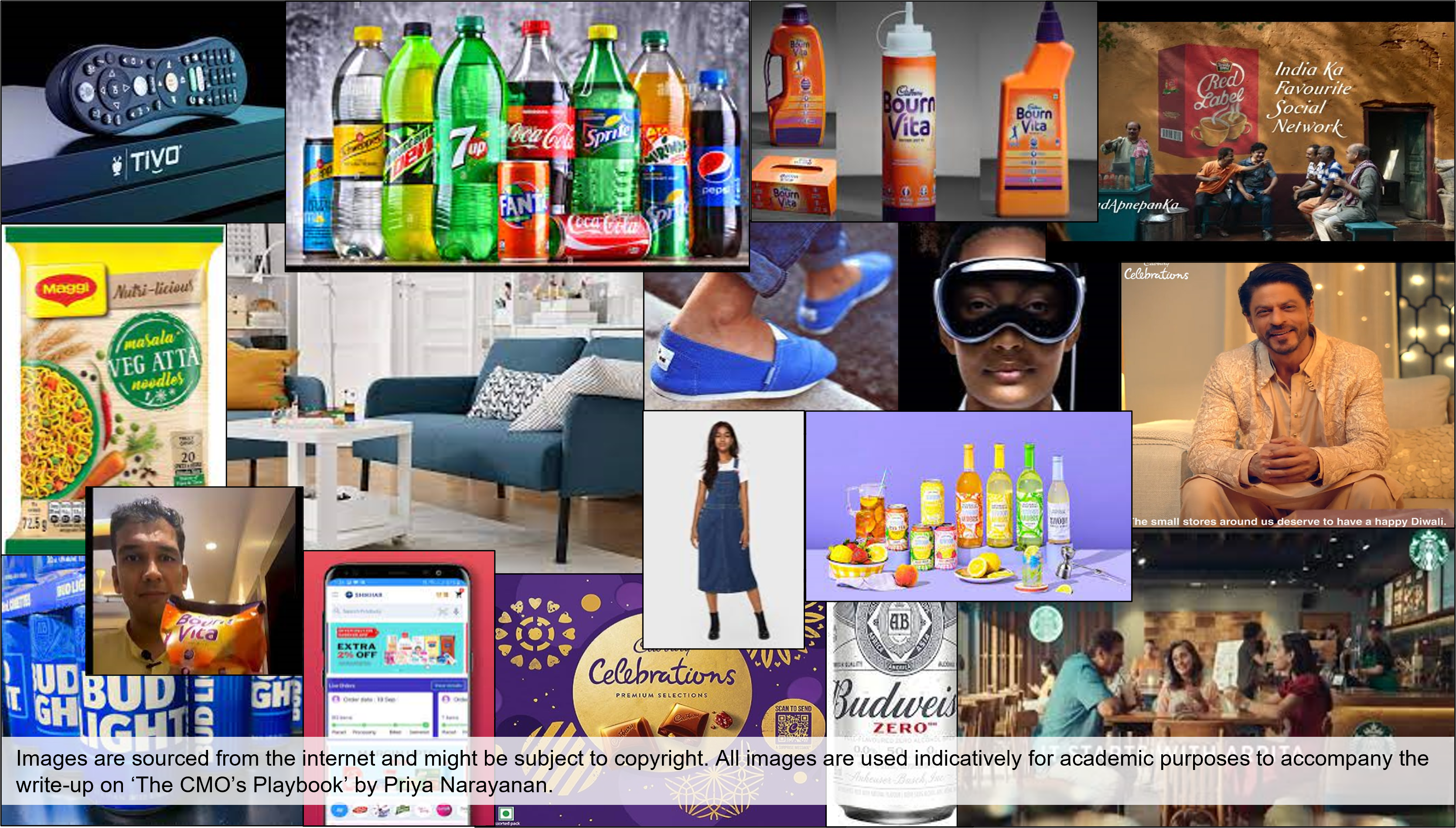
Here is a (hand-made) collage from the cases and contexts that we discussed in the course last year (2023 Jun-Aug). Can you identify all the companies and situations?!

*

Here are a few answers.

Coca Cola in India: A product portfolio worth boasting about, but who wants sugar and fizz now? This was (and is, and will continue to be) the dilemma of what is perhaps the world’s best built brand (for a brand backed by hardly any product worth its price). The new year spells interesting times for Coca Cola and more so for Coca Cola India with cannibals and competitors galore.

Continue reading

How NOT to Write a Research Internship Application!

After writing this up, I was in two minds whether to post it. But when I received an application that, quite confusingly, began: “Dear professor, my name is [your name]. I am a third-year student…”, I decided that time for this post had come. So here goes.

© Priya Narayanan, Assistant Professor of Marketing, IIM Kozhikode. Views are personal.

*

Dear internship applicant,

Every so often, I receive an email from someone among you – undergraduate and graduate – who wants to do a research internship with me. They are mostly alike. The ones I do take a risk on, by inviting for an interview and often taking onboard for a piece of work, are different, though. How? Those have a genuineness and care to the writing.

That set me thinking and I listed here, for your benefit, what to do and what not to do (the latter first) when writing a research internship email. This is all based on my experiences with prospective interns like you. Much of this is written in a light vein, in the spirit of laughing over one’s own flaws and picking up from wherever we are. I hope you have fun reading and applying this, because I had fun writing it!

So, here’s what to avoid in your email:

Continue reading

From the gallery to the well: A Wimwian’s reflections on the journey from student to teacher

© Priya Narayanan, Assistant Professor of Marketing, IIM Kozhikode. Views are personal.

This article narrates the story of my academic journey, and my admiration for my teachers at IIM Ahmedabad, and was first published in Writing on the Wall (Issue 5, May 2023, page 53), the annual students’ magazine of IIMA. The full magazine is available at IIM Ahmedabad’s LinkedIn post here.

Caution: The article contains an inordinate number of references to I, me, and my, and is best suited for fans of Priya Narayanan!

Late in the summer of 2009, I officially became a Wimwian by enrolling in the PGP and received the keys to my room in the “dungeon” of Dorm 3, where the sun hesitates to enter and a sweater is needed even at midday in the peak of winter. What followed was a hustle of classes in the gallery seating of b-school classrooms – for the first time ever in my life, I was not on the first bench! – and a life packed with activities and placements. Later, the place felt home enough to return for a second stint, this time for a doctoral degree in a topic that had become my favorite over the years, consumer psychology.

Continue reading

Learning Marketing from Shelby Hunt – A Tribute

(c) Priya Narayanan, Assistant Professor of Marketing, Indian Institute of Management Kozhikode

Caution: this article is on academic research. If that isn’t your cup of tea, you could read my recent popular article on The CMO’s Playbook instead.

Context of this article

About three months ago, reading (again) Shelby Hunt’s “The nature and scope of marketing”, I decided to write to Prof. Hunt, not with any particular research question or objective, but to interact once with the great mind that could, in one sweeping paragraph, summarize all of marketing till then:

“During the past three decades, two controversies have overshadowed all others in the marketing literature. The first is the “Is marketing a science?” controversy sparked by an early JOURNAL OF MARKETING article by Converse entitled “The Development of a Science of Marketing.” Other prominent writers who fueled the debate included Bartels, Hutchinson, Baumol, Buzzell, Taylor, and Halbert. After raging throughout most of the ’50s and ’60s, the controversy has since waned. The waning may be more apparent than real, however, because many of the substantive issues underlying the marketing science controversy overlap with the more recent “nature of marketing” (broadening the concept of marketing) debate. Fundamental to both controversies are some radically different perspectives on the essential characteristics of both marketing and science.” (Hunt 1976, p. 17, emphasis added)

Reading this the first time, towards the end of the second year of my PhD, I was not impressed. But, having read and written and thought and analysed much, I start to sense in Hunt’s writing a comprehensiveness, clarity, and directness that was not visible to me earlier. To learn that the author of this writing is no longer with us and that the meeting I considered requesting (I even wondered which email address would Prof. Hunt be reachable at, since he had recently retired from his long-standing faculty position), left me with a sense of loss that I did not anticipate. This article is an attempt to understand why.

Continue reading

Towards The CMO’s Playbook – A reflection on teaching and learning marketing strategy

Two months ago, forty-seven eager young minds started on a quest for “the CMO’s playbook” – a journey to understand strategic decision making in marketing. An equally eager but not so young mind (yours truly) joined them, mainly to prove that fun and learning can go together. It was a tall ask from all of us, but we managed to pull it off!

Finally, it was the student teams that prepared their original playbooks for CMOs, and I might have merely orchestrated the journey – a journey through a mix of simulation, business cases, discussions of real life marketing, and minimal reliance on pre-cooked frameworks.

Continue reading

To My Students – Soar High and Fly Far!

© Priya Narayanan, Assistant Professor of Marketing, IIM Kozhikode. Views are personal.

There’s a glorious joy in standing next to your peers, wearing the black robe, and receiving the degree. There’s a sense of two tumultuous years of struggle, fun, excitement, boredom, stress, success, and learning, all trying to bundle themselves into a few joyous moments.

On this convocation, as my first set of students graduate, it is no exaggeration when I say that I feel the same joy as I did over a decade ago. Of course, this time round, my joy is for all of you, my students, who made me a teacher. Because you created every moment that I have been a teacher.

You made me think, you made me laugh (and cry, believe it or not!). I doubted myself, then conquered those doubts, only to have other doubts come up. I became more empathetic, inclusive, confident, perceptive, all through your relentless training. And by now I have forgotten how I have also been irritated and desperate!

Thank you for everything.

Whatever you did as a student, whether you prepared or not, spoke up or not, turned on your video or not (!), I hope you gave your best. Because to give our best is all we can really do.

Soar high and fly far! The sky awaits with promise.

The sky on convocation eve at god’s own Kampus!

P.S. When you come back to campus, all grown up, do say hi because I fondly remember every one of you!

Stop Talking About Her, Talk About Her Work

What are the issues that women professionals face in their organizations? What are the benefits they bring to the organization? How can organizations bring out the best from their women professionals? Here is my take.

© Priya Narayanan, Assistant Professor of Marketing, IIM Kozhikode. Views are personal.

*

Now that the Women’s Day hoopla is done, it’s time for sensible views on women in business. This article is a collection of lists: the real issues faced daily by women in business; the real value that women add, over and beyond what regular employees aka men add; and the real action that everyone in business can take to realize the potential of women for their business success, and for justice in its most modern form. The article does not provide any advice to women, as most women are already taking several steps on their own, and non-contextual advice is often less than helpful.

Here are some real issues faced by women in business, daily and cumulatively, presented as quotes modified from my observations:

Continue reading

The Ferrari Formula: A Ferrari in Every Home. Really?

© Priya Narayanan, Assistant Professor of Marketing, IIM Kozhikode. Views are personal.

From a well-known brand of racing cars to a fashion brand label, Ferrari has come a long way. Yes, you read that right, Ferrari is now selling in-house fashion apparel. Here’s a video of the models on the ramp, oops, on the Ferrari production line. Are we witnessing the democratization of luxury, or is this just another unimaginative attempt to milk the market?

So, Ferrari seems to say: If you can’t buy the car, you can buy the jacket. Or at least a cap. But then you could always buy Ferrari merchandise earlier through franchisees. These branded products have been used in product placements as well. (A hilarious scene in the Bollywood movie Munna Bhai MBBS shows taporis whisking off a tourist – wearing a Ferrari red cap – to supply a personal cadaver for Munna Bhai, the doctor-to-be, to tear apart and learn.)

Continue reading