Tete-a-tete with a Teacher

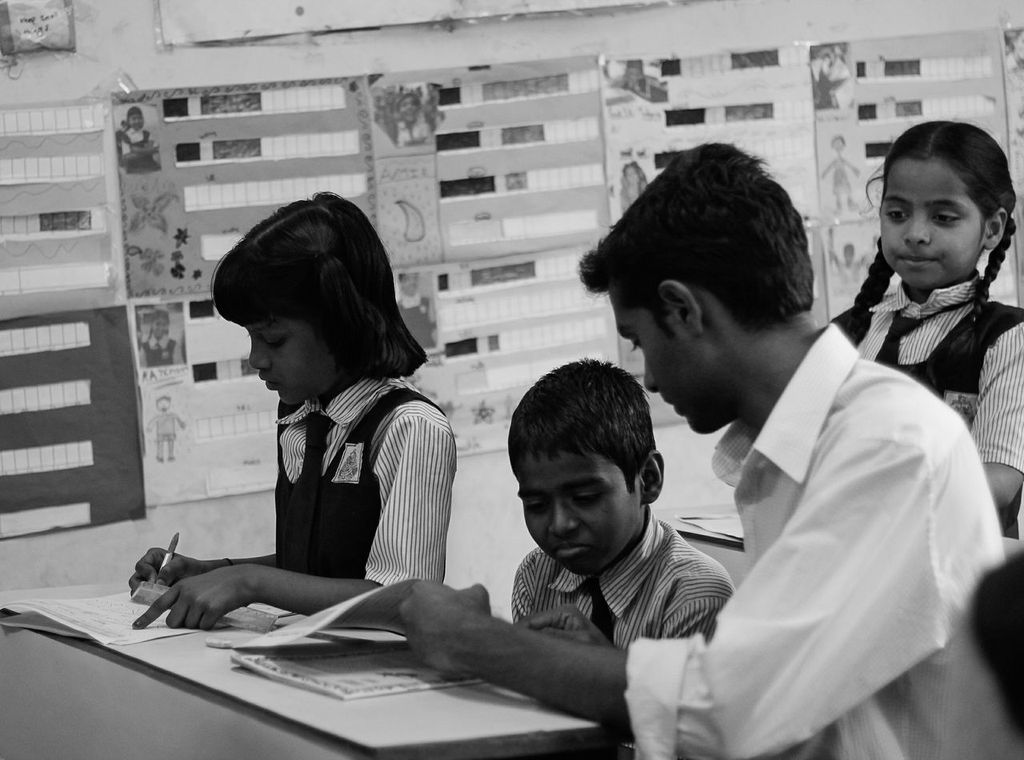
From a half-interested Engineering student to a passionate teacher and an educator on a mission – this is the transformation that choosing Teach for India has wrought on Prasid. The change in this former classmate of mine parallels the transformation of many of Prasid’s students at Varsha Nagar School in Mumbai. As a regular visitor at the school, I felt that this was one story worth bringing to my readers.

“I had finished my MBA, and could get a well-paying corporate job. But why take the well-trodden path? Why not take up something that would give me the opportunity to make a real difference?” Prasid’s words today, as he explains his reason for joining TFI, strike at the core of those of us who sweat it out climbing the corporate ladder.

Who's the teacher?!

Who’s the teacher?!

From the beginning, the 31 students of grade 3 staked claim to Prasid’s life, which revolved entirely around lesson plans, field trips, assessment tests and fundraising. Between teaching his “kids” to independently read the unabridged Charlie and the Chocolate Factory and getting them to understand Pythagoras Theorem, between taking them to watch other TFI children perform The Wizard of Oz and playing badminton in the school hall, two years went by almost too soon. Looking back, Prasid feels a mix of nostalgia, satisfaction and the urge to do more.

I ask Prasid for experiences that stand out in his mind, and he tells me there are simply too many of them. He narrates the story of Priti who has now attained international grade 6 in English comprehension and won an elocution competition among eight schools. Not an insignificant achievement for someone who didn’t know any of the subjects, often resorted to copying in class, and used to be beaten at home.

Atul today stands out by his brightness, and is the wittiest kid in class. As a child who was severely ill-treated at home, he initially came across as disengaged in class. However, when he was given the freedom to be himself, things changed, seemingly miraculously to someone not aware of what Prasid did. Shifa was someone with whom Prasid nearly “lost hope after six months” of efforts. She came from a broken family, and her mother was illiterate to the level of not being able to sign a document. Today, Shifa is a bright student, creative and talented in the arts.

We are friends

We are friends!

These stories illustrate Prasid’s firm belief that teaching is much more than disseminating content, it involves giving attention and love, and truly caring for the children in the formative years of their lives. Which means convincing parents of a girl who dropped out midway to get her back in school, periodically visiting the homes of the children, and getting buy-in from other teachers. In short, keeping hopes high always. Which wasn’t as difficult as it sounds. “There was never a need for a holiday because my work itself was so rewarding and satisfying,” says Prasid, “Teaching never felt like a chore that I needed a break from.”

The kids will miss Prasid bhaiya and he will miss them as well, when another TFI teacher takes over the class this academic year. But then, the change that took place in all 32 lives will have its impact forever. As Prasid now looks forward to managing two schools started by a corporate, let’s wish him and his counterparts at TFI all the best, in their aim to transform India’s education sector, student by student, school by school.

Bad boys, baddy boys!

Bad boys, baddy boys!

Want to know more about what Prasid has done? Check out the Facebook page here. Have something to say to Prasid? He can be reached at prasid@gmail.com and @prasids

The Extraordinary Lives of Ordinary People

1. The Lady to Libya

“After 6 months, I will get a family visa, I can bring my children also…” She is a nondescript woman in salwar-kameez on her way to Delhi. It’s her story that merits mention. She is headed to Libya, as a nurse in a government hospital. The agency that arranged for her job and visa will pick her up in Delhi. “There are six of us from Kerala, some others from other places. The important thing is to somehow get through the first six months. After that I can bring my family.” Her husband and two children, aged three and one-and-a-half, will manage on their own till then.

“I have to go there and learn Arabi. Don’t know what the food will be like. But what bothers me is how the children will live without me.” Her soft eyes fill up in a moment, but then the tears go back in.

2. The Serious Young Lad

He sits clutching his bag, trying to be casual, preoccupied with something. “There was a death in the family – illness and old age, so nothing unexpected, but the date was unexpected. So I had been running around a lot for the arrangements.”

He has spent six years in the same company, a bank, after graduating with a degree in Math. He likes his life – a 9-5 job, some football, some volunteering – he is glad that he has a life outside work. “My job is changing now, I have to get sales and not just make sure that things are running smoothly.” He is with a group of management graduates now, who have experience in other banks. “Those guys are paid more simply because they have an MBA. What do they do differently?”

3. The Studious Cabin Attendant

She is studying for an exam on flight safety. As a cabin attendant, she has to give an exam every six months. The tests are more than academic. “We have to watch our weight – we can’t be overweight. We can’t be underweight either, because then we might fall ill. They give us time to come to the right weight, so it’s ok. It’s difficult when you eat food like this all the time,” she says, pointing to the sandwich.

The job pays well, but “the glamor is not as high as it used to be.” It is hard work as well, with 25-30 flights a week on average. “After five years on the job, you are not allowed to be a court witness. Because when you take so many flights, you tend to lose your memory. Your memory becomes unreliable.”

4. The Loving (?) Mother

The mother, the 6-year-old son and the 8-year-old daughter have all got middle seats. The children have settled down nicely in their seats, but the mother is restless. “Do you mind shifting? My daughter is very uncomfortable sitting alone. She wants to sit with me.”

The son stares at the mother across the aisle, with an uncomprehending look. The daughter turns back from where she is sitting with an open paperback novel – her discomfiture arises from the loud voice of her mother and the embarrassing topic of conversation. She wishes her mother wouldn’t make a scene, it’s only a couple of hours after all. But sometimes mothers miss their children more than the other way round and possessively try to allay imaginary worries.

5. The Entrepreneur’s Daughter

She is like any other college student, living with friends in a hostel. But her sights are set high. “I want to do an MBA abroad and then return to work in the family business.” Her father built up a pharmaceuticals company, and the responsibility to run the business will soon be on her shoulders.

The expectations are high – the father has won an Ernst and Young Entrepreneur Award for his work. The Award that let her spend a week at Stanford learning about running the family business. And made her more confident of her decision to learn business right after undergraduate studies, unlike many of her classmates. The father is an entrepreneur, but the daughter has to be a manager.

P.S.: All the above are snippets of conversations with fellow travellers on flights…

-~-

Stark Reality, Simply Narrated – a Review of ‘Behind the Beautiful Forevers’

There are some books which you know are good, but you also know that they are so tangential to what you do on a day-to-day basis that unless you set apart solid time, you won’t get around to reading them. And so you avoid thinking about them, and even when you see such a book lying on a colleague’s table, the bookworm in you starves itself by ignoring the book. Such are the woes of those of us who go to work every day.

And yet, sometimes, there comes a day when the book returns to you, and you end up reading it in spite of yourself. And you realize that it was worth it. That’s how Behind the Beautiful Forevers turned out to be. <Warning: multiple plot spoilers ahead.>

Pulitzer Prize winner Katherine Boo’s BTBF is the real story of a few families and street children living in Annawadi, a nondescript slum near the Mumbai airport. Among them are ragpickers and slumlord-hopefuls, animal lovers and teachers. There are children grown too old too quickly by poverty, there are friends who know that to help someone is to invite disaster upon oneself and to share is to starve, and there are opportunists who know the multiple sources of money in an impoverished slum.

When a handicapped woman attempts suicide, only to regret it immediately, and then dies in hospital, her neighbours are arrested and incarcerated for murder. The subsequent trials take their toll on the Husain family not only because of the loss of income of days spent in jails, but also because of the uncertainty of whether the father, son and daughter would ever be released from prison. The family takes an impossibly bold and apparently reckless stance of not paying anyone despite repeated offers from various quarters to “help” them be declared innocent of a crime they did not commit.

When Abdul muses that Kasab, one of the perpetrators of the terrorist attack at the Taj in South Mumbai, has at least the saving grace of being tried for a crime he did commit, it reeks of resignation at a political and judicial system so convoluted that it is effectively unable to determine innocence and guilt: the only color it recognizes is that of money, the only command it follows is that of power. When Abdul and his family are acquitted, seemingly more by chance than by design, there is no particular victory to be celebrated, only a permission to go on living that was nearly too late in coming.

BTBF also reminded me of a mildly unsettling realisation that I had been conscious of since I started travelling on work, coming into contact with staff at airports, hotels, taxis and offices: to be nice to such people is not an act of generosity on your part, it is a privilege granted to you. It is only the rich who can afford to be nice, to lavish money on tips, to pleasantly wait two more minutes as the room is readied, to smile at the housemaid. For the ragpickers who “earn to eat,” niceness is a luxury they can neither afford nor gain from. (If this sounds moralising, let me flatter myself that the years have made me wiser!)

For what is Boo’s first full-length book, BTBF is very well-written. What I liked best was the impeccable flow of the narrative that gives hardly a hint of the copious amounts of research and file-chasing behind the facts. Unlike the exclamatory tone adopted by many first time visitors to Mumbai and its slums, and unlike the patronising optimism of Slumdog Millionaire, BTBF possesses a clearheaded voice, unassuming but sympathetic, pragmatically limited in its sentimentality and hopefulness. After all, the lives of Akbar and Sunil and Asha and Manju are not going to change in a day. At the same time, this also makes the purpose of such a book unclear. Yes, it lays bare the stark reality of life in a slum next to the gleaming airport, but there is no call to action. Then again, who is to say what the right action is?

Despite being a work of non-fiction, BTBF also bears similarity to City of Joy, a novel by Dominique Lapierre on life in the underbelly of Kolkata in the 1970s. The book traces the lives of people as diverse as a rickshaw-puller, a Polish priest and an American doctor, all linked by their lives in Anand Nagar (the “city of joy”), a slum in Kolkata. Lapierre’s description of the rickshaw-puller Hasari Pal’s life left such an impression on the class nine student who read the book (yours truly) that she could never be at ease in the cycle-rickshaws of Gurgaon, years later. Indeed, during that stifling summer, the one-hour walk from office to home was preferable to the discomfort of seeing an invariably reed-thin man sweat for me. It tore my heart whenever he bargained to transport the three of us for an additional ten rupees on his own rickshaw, rather than let one of us take a second rickshaw. But I digress.

~*~

P.S.: I had meant this post to be only a review of BTBF, but felt that it had to do justice to how I ended up reading a book I had deliberately kept off my regrettably short reading list. Many thanks to the protagonist of the first two paragraphs.

Memories of Orissa

A selection of thoughts and feelings from a recent trip to Bhubaneswar and Cuttack in Orissa, where I was

  • Awed by the granite structure of the Sun Temple at Konark, and awestruck when told that these were mere remnants and that the erstwhile main structure was more than double the height of the existing temple
  • Amazed at how each of the small dots, on the rim of each of the twelve twelve-spoked wheels of the chariot that is the temple, corresponded to exactly three minutes
  • Irritated at the mindless enthusiasm shown by everyone, including my friends, for photography – much more so than at the Taj Mahal: both the enthusiasm and the corresponding irritation. Clicking one picture for memories is acceptable, but going to a monument or scenic location does not transform you to an advertising model worth GBs of photos to be forgotten in a week
  • Struck by the realization, accompanied by a curious lack of surprise, at the Jagannath Temple at Puri, that God’s blessings can be bought, and that perhaps purchase was the only way of obtaining blessings there because you needed a ticket to reach the sanctum sanctorum. Which, as a philosophy taken to the extreme, would mean that the rich would become richer and the poor poorer. Not a sustainable belief by any means
  • Disappointed at the basket of sweets I bought because the 3-4 different items on the top didn’t reveal the fact that below the top layer there was only one kind of item (possibly the cheapest) that filled the basket
  • Drawn to stacks of brown sweets – fried layers of flour, coated with white powdery sugar that soon turned our fingers sticky and lick-worthy – at a roadside stall
  • Hungry but happy, as we sat on the floor eating tongue-scalding steamed rice and thick yellow dal and several side dishes from leaf-plates and earthen cups. The sale of this food, which was brought out from the temple after puja and which seemed to be meal offerings to the deity, was by itself serious business for numerous authoritative-looking raucous-voiced people
  • Visited by nostalgia at the sight of sewing machines in a handicraft shop at Pipli, where the old man explained that he and his wife had themselves made by hand all the bags and wall-hangings displayed in the shop
  • Intrigued, at the Buddhist Stupa at Dhaulagiri, by the sight of small boxes that served very effectively as printing cabins for quick photographs. The Stupa per se was hardly impressive but the printing set up intrigued me enough to take a picture and post it here:
Printer Setup at Dhaulagiri

The intriguing printer setup at Dhaulagiri: the little black object in the centre is a Canon colour printer!

Interesting Stuff from Around the World – Edition 1

This time you get to read some interesting observations, picked up over the past few days from the news and from conversations. Not surprisingly, the post is littered with more links than usual.

1. To work from home or not

Marissa Mayer created ripples when she announced through an internal memo Yahoo’s decision to seriously discourage working from home. Industry bigwigs have not finished decrying the decision. However, there are some benefits to working at a central office, and these benefits are lost when working from home becomes the default. Chance encounters and conversations do have their value. Penelope Trunk’s blog has a post which provides views in support of Mayer’s stand.

Here’s my take on the idea of working from home: see what you and the team want to achieve in terms of innovative ideas, productive undisturbed work, personal time off and so on, and use working from home as one of many tools to attain a good mix of these goals. The important point to keep in mind is that in demanding jobs, especially those which are not 9 to 6 jobs, the company cannot say “you are responsible for the work, the company does not care about your personal time” because if a company draws out the best in you, it is obliged to help you find the best in yourself by helping you find space for personal life. In any case, companies must realize that the most motivated and best performing employees require flexibility simply so that they can continue performing well, as this article says.

2. The oath of the who???

The Oath of the Vayuputras. That’s what every cat and dog I know is reading these days. I’m curious but having very recently laid hands on Love in the Time of Cholera, there’s no way I’m jumping on the Amish Tripathi bandwagon now. The point here is what this book has achieved, and I don’t mean spreading the reading habit or developing English language skills.

Instead, what I’m referring to is the fact that many of my friends have pre-ordered online a book for the first time in their lives. Before The Oath, they had always carried out one of four options: bought pirated books on the roadside, bought books from Landmark and Crossword, ordered books from Flipkart, ordered ebooks online. Now for the first time, they have pre-ordered online a book, that too not an ebook. I think there is a shift in consumer behavior here.

3. Paying for email

A radical idea came along in an article by angel investor Esther Dyson in the Mint the other day – instead of free email and the consequent spam, get the sender to pay and the recipient to set the price for reading email. After all, each email requires the receiver’s attention, and I’d certainly be glad if there was a way I knew the sender was sufficiently invested in the matter to warrant my attention.

Regarding questions like how the pricing would work or the complexity of the system, I agree with the author: these are operational questions, they would get sorted out over time. When people are ready to pay for what they find valuable and/ or scarce, it makes ample sense for them to pay for someone’s attention. But then again, bring money into play and you risk bringing inequality where there was only inaccessibility.

A Visit to Britannia, Mumbai

It was nearly a year ago that I went with some colleagues for a birthday lunch at Britannia in Mumbai. The experience was so enjoyable that I not only ended up writing a review and submitting it on Zomato but also winning the weekly ‘Write for a Bite’ contest. The review is available on the Zomato site.

We went with a vague sense that the birthday boy would “treat” us (meaning, he would foot the bill) but as the food vanished from the plates, someone came up with the idea that the group should treat the birthday boy. The idea quickly found support, and so we returned with lighter pockets and happier minds!

Here is what I had to say on the restaurant:

An old-time restaurant where a stately portrait of H. H. Queen Elizabeth II watches over you as you tuck in, a place that sports old-fashioned signs telling you to “not argue with the management”, Britannia is a homely Parsi restaurant. A bunch of us went for a birthday celebration lunch the other day and came back satisfied.

I must confess that I entered the place with a mild sense of apprehension, since my friends had told me that you get very good non-veg fare at Britannia, implying that the veg fare could be less than charming. However, I was in for a pleasant surprise, which immediately endeared the place to me: the ‘berry pulav’ at Britannia is a must-have – it looks and tastes different from every other rice dish, as the warm flavor of rice brings out the tart taste of berries.

My friends say that the ‘sali boti’, a spicy meat dish with crisp fried potato shreds sprinkled over it, and the ‘kheema berry pulav’ are stuff they would like to have again. We ordered each of the three desserts on offer, and while they come in small servings (which is good if you are watching your calories!), each one had a strong individual look and taste. The ‘caramel custard’, delicious without being too sweet, turned out to be my favourite after sampling all three.

As would be clear by now, variety is not the hallmark of the place. The entire menu fits on one side of a large-ish card. Indeed, I found it interesting that the menu card was placed below the glass topping of the tables, making for a very convenient choosing process. The seats are closely placed and the service is decent, and the place is not too harsh on the pocket. Of course, Britannia does not offer high-class fine dining, but it never promises to! All in all, an affordable and homely place where you will enjoy going with friends and family rather than with colleagues.

Note: Copyright for the restaurant review is subject to Zomato ‘Write for a Bite’ contest rules.

On the Biscuit Trail, Sightseeing (Notes on Hyderabad)

“I have orders for fruit biscuits from Karachi Bakery,” said my friend, as we set off from the guesthouse to the venue of S’s midnight wedding. “So do I,” said the third member of our party. By then, yours truly was torn between curiosity and the need to feign awareness.

“Karachi Bakery? I can tell you where that is,” said the otherwise reticent man who drove our car, suddenly becoming loquacious in describing the location of the apparently famous shop. So I was the ignorant one. But only for a minute longer. My friends soon told me how S used to bring those biscuits to their hostel whenever she came back from home, and how they all used to “just love it.” The next day, these two friends skipped a part of the post-wedding puja in order to trace Karachi Bakery and buy huge quantities of the said item. All this was why I decided to stop there on my way later from Salarjung Museum to Begumpet.

On Nizam Shahi road, the huge blue and pink signage of the bakery stood out, and the crowd in the store, engrossed in Christmas purchases, reminded me of Mumbai. The matter-of-fact way in which I was handed a sealed packet of fruit biscuits and a piece of the same to taste was a mild letdown: I had expected, quite unreasonably in hindsight, that such a famous item would evoke a sense of awe in its handlers. Nevertheless, I could see that customers in that particular section of the shop were reassuringly enthusiastic.

The welcome that the biscuits – square shaped cookies with tutti frutti and cashewnut– received at home was little more than lukewarm, perhaps because they were poor competitors to the thick home-made jaggery pudding prepared the previous day. The tales of visits to Golkonda Fort, Charminar, Birla Mandir and Salarjung Museum found more enthusiastic audiences.

To whoever would listen, I repeated stories that the guide had narrated, of the intriguing history behind various features of Golconda Fort, including how sound was transmitted from the gateway at the entrance and the reason behind the name of the fort. We could see that although large parts of the fort were destroyed by Aurangazeb, the existing structure was deemed worthy as a film setting, for we came across a full-fledged team shooting a movie and two youngsters repeatedly trying to record a short amateur dance video.

At Charminar, it was the apparent lack of functional purpose of the building that bothered our party initially. A little like the Gateway of India, said one of the viewers. But the bangles and pearls at Laad Bazaar made up for that.

At Birla Mandir, I was amazed by the devotion shown by the crowd as everyone chanted “Govinda, Govinda” in a peculiar and catchy rhythm. The whiteness of the structure stood out in stark contrast to my memories of temples in Kerala made of dark granite. The art exhibition at the adjacent Birla Science Centre complex was worth seeing but hardly attracted visitors, who were more interested in watching the show at the planetarium and the huge skeleton at the dinosaurium, and in exploring the interactive science exhibits.

Salarjung Museum was huge and well-maintained. The various forms of Arabic calligraphy caught our attention, including the Tughra style where the letters are used to form the shape of an animal, bird or object. We stood captivated by the Veiled Rebecca, a life-like and delicate depiction of a demure woman, sculpted in white marble. In several rooms, the utility items and ornaments of the royal family reflected taste and indulgence, craftsmanship and lavishness. We returned from the museum having covered only the central block, leaving the eastern and western blocks for another visit.

Back home, most of the Hyderabad saga was forgotten amidst the holiday season. But I was in for a pleasant surprise when I casually offered the fruit biscuits to a friend. “Karachi Bakery!” he exclaimed, in instant recognition, although the biscuits were no longer placed in their original box. Here, now, was a very memorable brand! Going on the biscuit trail in Hyderabad was worth it, after all.

‘Life of Pi’ – A Fantastic Spectacle, and Two Questions

A children’s fantasy that anyone would enjoy watching – this is my take on Life of Pi, the recently released movie based on Yann Martel’s Man Booker Prize winning book of the same name.

Directed by Ang Lee (of Crouching Tiger, Hidden Dragon and Brokeback Mountain fame), Life of Pi narrates the story of a 16-year-old boy named Pi Patel who is marooned in the ocean with an adult Bengal tiger Richard Parker. While being a tale of determination and survival, Life of Pi is also a tale of empathy and humanity: Pi not only manages to keep himself alive on the lifeboat for several months, he also ensures that Richard Parker survives the ordeal.

The narrative of the tiger with a human name and the boy with a quasi-animal name (Pi is short for Piscine, not the most common of first names even if the surname were something other than the very Indian one of Patel) hardly deviates from that of the book.

The movie is very well-acted, with Suraj Sharma and Irrfan Khan etching the roles of the younger and older Pi respectively, with the right amount of drama and sensitivity. The tiger is a brilliant feat of animation, especially in the life-like way in which minor movements such as twitching whiskers and heaving breath are captured, given that most of the scenes involving the tiger did not use a real tiger. Check out this link for more on how Richard Parker was brought to life. The special effects, such as the flying fish, the phosphorescent sea and the dreams of Pi, are surreal, and the sounds add a dramatic touch. Through most of the movie, you don’t notice how the time passes. Even Pi’s sense of wonder at seeing the luminescent ocean seems believable.

And yet, there are elements that could have been done better. The English dialogues are incongruous in most places – it is difficult to imagine a young Tamil dancer and Pi speaking to each other in any language other than the local language of the place in India, which is anything but English. There is also too much time spent on existential questions and on faith in God. If the movie was meant to be a fantasy, why engage the rational mind for so long while enthralling the child in us with a marvelous spectacle? The situation brings to mind children’s books which have big colorful pictures covering most of the page, with the detailed story written out in tiny font at the bottom which only the parents are expected to read.

It also seemed odd that the audience needs ratification from a Westerner that this is a fantastic story. The story would have been just as powerful without someone on-screen having to express incredulity. The saving grace here is that Pi himself, when he recounts the story, is not looking for such approval. The Westerner listening to the story expresses his admiration only because he thinks that is expected of him.

That aside, there is an interesting scene that, to me, captures the gist of the movie and what it tries to convey. (The movie clearly has something it stands for, it is not contented being merely a children’s story.) As Pi describes his experiences to the representatives from the Japanese insurance agency, they tell him that bananas don’t float on the ocean. Really? I clearly remember a scene where the orang utan moves towards Pi’s lifeboat over a few bunches of bananas. But then, that scene was part of Pi’s narrative, so just like the Japanese agents, I too am unsure of whether to believe Pi or not.

Something that struck me as the movie progressed was that, for a boy of 16 years, Pi is inordinately conscious of the importance of Richard Parker in helping him survive, by being a ferocious carnivorous wild animal that he has to be wary of. Pi is also aware that both he and Richard Parker are cast away on the ocean, clueless and unexpectedly, and that he is responsible for the tiger’s survival. But then he has been philosophical from the beginning.

The poignant question of what it means to be human, as opposed to being savage or animal-like, was something I remembered hitting me as I read the book, and it comes across in the movie as well. For those who haven’t read the book, the idea would be even more striking.

In the end, as the names of the cast float upwards on the screen, I am left with two questions. Was this movie meant for adults or kids? And do bananas float in seawater? Neither one takes away from the fantastic spectacle though!

Changed but Still the Same (Notes from a Homecoming Trip to Wimwi)

After the awe of seeing the red bricks subsided, one of the first feelings I remember from my day of arrival at Wimwi* is the intense disappointment on seeing the dorm* room allotted to me – old, nearly unfurnished, paint flaking off and falling to the bed along one entire wall. Dilapidated, in one word. To think that this was what I had “achieved!” I was immediately and very kindly allowed to change my room. And after that first day, I don’t remember ever having had a chance to reflect on the quality of my accommodation.

<Before we proceed any further, some comments are in order. In this post I have used terms commonly used at IIMA – these are indicated by * at their first occurrence and explained at the end of the article. This post is also on the longer side, so please be warned. But if it is as much fun reading as it was writing, you wouldn’t notice the length.>

Going back to campus after a hiatus of a year and a half, the overwhelming sense of homecoming eclipsed all other feelings. The dorm room I got this time was no better, but time had changed my perspective so much that campus felt like a nature resort. And the days passed by in a rush. I strongly suspect that time runs at a different speed at Wimwi. Time is also scarcer, and hence more valuable and more valued, at Wimwi than anywhere else in the world.

Fences and facilities

I noticed that the campus seemed demarcated by fences in an attempt to keep away the stray dogs, a vain attempt because the gates of the fences usually remained open. Indeed, there is something about an academic institution that makes spirits far freer than in an organization that pays a salary for working, for keeping your ideas to yourself and for doing what you are told. In the latter, the chaos of enterprising free human minds is mercilessly reined in by rewarding subordination.

It was heartening to see the new sports complex, with an indoor badminton court – so what if it was not equipped with the best of lighting? And the SAB, the Student Activities Block, which has been a long time coming; the new super posh dorms of rooms with attached bathrooms – a rare luxury for the students of Wimwi; two more ATMs, in the right places; more, and yet inadequate, signboards to indicate directions to dorms and facilities in a campus that seems like a maze even to seasoned residents.

Food and fauna

I spotted more eating joints – the expensive but healthy Joos has been relegated to the realm of memories and only the space remains, as if awaiting a new occupant; there is Falafal (think Hindi not Lebanese) aimed at the same I-care-more-about-health-than-wealth customers (I exaggerate, of course); a Nescafe right near the girls’ dorms; an enlarged Nescafe in the new campus. And KLMDC* still sells home-made cookies, these are still just as popular; the fruit vendor still enjoys a monopoly; tiffin deliveries take place as usual, of packed lunches that look unhygienic but taste genuine like only home-cooked food does; the food in the student mess has expectedly gotten worse over the years and subscription seems to have fallen each year.

The animal kingdom at Wimwi has not diminished even one bit. At Falafal, a bold squirrel approached till the seat opposite mine, and stood poised to land in my plate with its next jump. I threw a yellowed neem leaf to the floor and the squirrel, well-trained as it must have been from numerous titbits thrown by residents, ran towards the leaf. But very soon it was back, and this time I broke up a corner of my bread slice and offered that. The squirrel sniffed around, but could not (deliberately did not?) spot the meal, and returned to its pose, again ready to jump onto my plate. In the meantime, another squirrel grabbed the bread piece and ran away. I have a feeling that squirrel one often helps its brothers this way. In the land of RG-giri* this was a refreshing sight.

Reading, living and studying

The best-kept secret of the Wimwi campus, VSL, or the grand old Vikram Sarabhai Library, is still majestic and well-maintained. It hasn’t lost its charming effect on me – within minutes of entering the welcoming silence, I noticed and picked up Stephen King’s ‘On Writing’ in the new arrivals section and Peter Drucker’s ‘Adventures of a Bystander’ in the shelves, both of which I had been planning to read.

In dorm 3, the same old almost shelf-less fridge reigns over the pantry, but the new microwave oven has stolen the spotlight from the old one; the basement, known lovingly among current and former residents as the dungeon, still has some of the least wanted rooms and the most well-bonded group of residents; the erstwhile cleaning lady has been moved out, but the mildly servile attitude has remained, now shown by the new cleaning lady.

There is no more a WAC run* because electrons run faster and the Internet has taken over the work of fast feet. But Turnitin* does its job just as skillfully. And the 2.30pm surprise quizzes are back in the system (after having been displaced when first year classes were held in the afternoon as well because a new section of students had been added), with the additional caveat that the announcement comes only at 1.45pm! All those who thought it was a good idea to skip lunch because of (the possibility of) a quiz might consider eating because the suspense would not be broken before 1.45pm.

Outside the classroom

For students, placement is still the ‘top of the mind’ question. Professors, as has been the norm, show no recognition that the third slot* is the “killer slot” with classes in full swing, placement talks to be attended and placement preparation to be carried out by fachchas and fachchis* who are only just about getting used to the system. Some courses are no longer being offered but others are being offered in two sections due to overwhelming demand from students. Professors, I am glad to notice, are still sensible and high-thinking as they were in my time! The FPM* students have not moved out but they have moved on, just as I have, and they talk as easily of research as I would of client meetings.

That there was no Onam celebration on campus this year was surprising and unpardonable. Malayalis the world over are known for two things – for quickly bonding with fellow Mallus and for celebrating Onam wherever they are. The best aspect of such bonding, perhaps the one aspect that allows a seemingly insular relationship to flourish, is that the resulting group is very open to non-Mallus. Of course, only those who try joining the group will realise the warmth of the welcome they will receive. In my batch, our Spam* treats often included a friend who hailed from another state in South India.

Outside campus, there’s a flyover under construction, heralded by traffic jams and dusty roadsides; wayside eateries have moved to give way, but the taste of the roadside poha has not reduced one bit! Good old Ahmedabad is still the same – reckless driving on the roads; sarees worn the Gujarati way; a well-functioning BRTS (unlike in Delhi); and the winter approaching slowly, with its cold fingers reaching the dorm 3 dungeon first.

On the way back to the hustle and bustle of consulting life, I realised how true the cliché was: you can take the Wimwian out of Wimwi but you cannot take Wimwi out of the Wimwian!

-~-

The jargon

Here’s my attempt at describing the meaning of the slang terms that have crept into the post. Naturally, it is impossible to convey the complete sense of any slang. I haven’t given away much of the reasons for the terms, although there are traditional reasons for every term, nor have I expanded abbreviations. The terms are listed in the order in which they appear in the post.

Wimwi: IIMA

Dorm: A standalone set of 30-40 single rooms that has a culture of its own

KLMDC: The management development centre in the heritage campus (aka the old campus)

RG-giri: A kind of unhealthy competition prevalent among students of Wimwi, especially in the first year

WAC run: The process of running from dorm to classroom in order to submit in time a printed copy of a particular written assignment in the first year

Turnitin: The software that detects plagiarism

Slot: Half of a term; six slots make a year

Fachchas and fachchis: First year students

FPM: The doctoral programme

Spam: The Malayali students group
A Land Uncannily Like Kerala!

There is something very intriguing in the view from the aeroplane as it descends over Udaipur. The sheer greenery of the land below makes me wonder whether this is a verdant hillside of Kerala. And the roadsides bear a sight so familiar on the roads of Thrissur – wild creepers growing complacently on electricity poles and on the stabilizing steel wires joining the poles to the ground!

It is difficult to believe that I am in the state of Rajasthan which I have associated with deserts since learning about the Thar desert during standard 3 in school. Clumps of multicoloured lantana (kongini in Malayalam) on the roadside, an abundance of wild grass with yellow and violet flowers, fresh foliage on trees – the rain seems to have worked magic on the land!

I notice that shop fronts are covered with writing in Hindi, so is the wall space between shops, possibly because hoardings are yet to make their way into this place. Is this a land where people don’t talk much? And if they do, they perhaps speak in full sentences? I wonder, because the typical shop sign reads “groceries and household items are available in this shop” instead of the ubiquitous laconic “groceries and household items” that you see elsewhere.

While Udaipur is known for its lakes and palaces, there is more to the place. On our trip to Kumbhalgarh Fort, we pass roadsides so scenic that I have seen them only in old calendars: a gentle river meandering its way over stones rounded by years of flowing water, flanked on both sides by flowering shrubs and trees, and green mountains in the distant horizon. Knee-high man-made walls of weather-hardened cut rock crisscross the area, reminding me of some of the last scenes in ‘The Shawshank Redemption,’ and young shepherd boys guide their goats to grazing land. Schoolgirls wave at us as the bus passes; I remember reading somewhere that we are obliged to wave back, if only to keep hope alive in the minds of the enthusiastic children.

The Fort itself is well-maintained, its 36 km long wall stretching out ahead of us, encompassing several Hindu and Jain temples. Our guide is a small boy who goes to school in the morning and leads tourists through the Fort in the afternoon, regaling them with stories of the seven-and-a-half-foot tall king who reigned in the Fort’s heyday. We gasp and pant, our knees rebelling, over the rock-paved incline at the beginning, and wish there were banisters to hold while descending steps, but the boy is lithe, almost impatient, as he waits for us at the next interesting spot.

We sit on the stone steps in front of a temple and the mild breeze cools down the weary tourists. After a picnic lunch by the riverside, we are on our way back to civilization and pollution, honking horns and dusty air. But the enchantment stays with us, and before we leave Udaipur, we have all, with varying strength of intention, contemplated visiting the place again. I, for one, would like to see again this land in North-West India that uncannily reminded me of Kerala!