‘A Passage to India’ and Other Books

‘A Passage to India’ is a novel set during the later days of British rule in India, and I had expected it to be yet another, perhaps a little less clichéd, description of Indians and the Indian way of life as seen by an Englishman writing from his country or at most, writing based on his visits to India. But I was in for a pleasant surprise. E. M. Forster describes, in a nuanced and sensitive manner, how Indians and Englishmen got along with and sometimes did not get along with each other, as they inevitably came into contact.

The plot  in ‘A Passage to India’ is far from vast. It can easily fit into a short story – Aziz, a widowed Muslim doctor, offers to take Adela Quested and her future mother-in-law Mrs. Moore on a trip to visit the well-known Marabar caves in Chandrapore. Inside one of the dark caves, Adela imagines that someone tried to attack her and assumes without doubt that her invisible attacker was Aziz. He is arrested and tried in court, but before the trial is over, Adela realizes that she was mistaken and withdraws her complaint. Yet, the damage is done and many lives have been affected irrevocably.

The author leaves unsaid, but makes amply clear, that while these are important events in the lives of a few Indians and Englishmen, they illustrate merely another instance of the impossibility of true and trusting relationships between two groups widely separated by not just geographical and cultural barriers, but also the more divisive chasm that distances the ruler from the ruled.

For instance, open-minded Englishmen such as Mr. Fielding (whom Aziz gradually starts to think of as simply Fielding) might become friendly with Indians, but their English wives can never really mentally get past the distance. For all their determination to see the “real India” and their friendly disposition towards Aziz, Adela and Mrs. Moore are never truly at home in India.

Indians in the book are not blameless either, for they hold stereotyped views of the Englishmen and English women. With the caveat that what comes out in the book is perhaps the English stereotype of what the Indian stereotype of the English is. (The book is nowhere as convoluted as the sentence you just read, so do not let my analysis dissuade you from reading it.) In short, ‘A Passage to India’ is an eminently readable story, one of the rare books that make me wish I had read them earlier.

What I like best about ‘A Passage to India’ is the way Forster narrates and implies, but never brings himself into the story. In comparison to the two other books that I happened to read recently, ‘A Case of Exploding Mangoes’ (a historical thriller based on the death of Pakistani President General Zia ul-Haq) and ‘The House of Blue Mangoes’ (a mostly lifeless account of the lives of three generations of a family based in South India), ‘A Passage to India’ is a refreshing piece of work. It is as a novel should be – the characters are so important to you that at least for the period you are with them, you fancy that you care for what happens in their lives, you want to know how things turn out for them. In this respect, the book reminded me of ‘The Mandelbaum Gate’ by Muriel Spark.

The book that I am currently reading is just as powerful. ‘The Finkler Question’ (Howard Jacobson’s Man Booker Prize winner that is witty and sympathetic in equal measure) brings up severe issues with a gravity that is as unbelievable as it is real. Because that’s often how life is, a curious mix of the comical and serious. Julian Treslove is just another guy next door till he is mugged one night on the way home, and a phrase uttered by his assailant (a phrase which he isn’t even sure he heard right) changes his outlook to life. From the outside, there is no break in the flow of his life, but mentally he is a changed man. Not impossible, I suppose.

-~-

P.S.: With all this mention of books, it is very natural to wonder whether this consultant (yours truly) has been “on the beach” far too long. But the more pertinent question is whether this consultant has been on far too many flights…
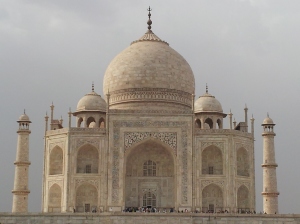
Before the Taj, Spellbound

This is about an impromptu visit to the Taj Mahal – a visit motivated by sceptical curiosity rather than by a sincere interest in historical monuments – and how it left me more amazed than usual.

The first sight of the Taj Mahal takes my breath away. Nothing in photographs or gushing praise from friends has prepared me for the sheer beauty of the white structure. It is solid yet weightless, rooted on its pedestal yet floating against the backdrop of the off-white sky, reaching up to the clouds. It is unearthly.

I am so captivated that I stand awestruck, to simply stand and watch and not take a step closer. The incredible lightness of the monument seems to arise from the fact that there is only pure sky behind the Taj, no greenery, no other visible buildings, no mountains. I am in the presence of something bigger than, almost untouched by, humanity’s everyday trifling cares.

Image of the Taj Mahal against cloudy skies

When there’s only the Taj and the sky

And the inside was as incredible as the outside: intricate patterns of flowers and leaves and creepers, all etched in delicate white marble using coloured stone. Even if they were paintings, these etchings would have been works of art. That they are made of resilient stone makes the achievement astounding.

When the setting sun shone down, the subtle play of light on the domes made the Taj glow as if it were made of pearl, the side facing the sun giving off a sheen that only white marble can. At times, the building seemed to shimmer and float. As the sky grew darker with rainclouds, the white structure stood out even more, pale and light yet unshakeable.

I wondered at the vastness of the mind that envisioned such beauty before it was manifest through the monument. And I sat at a conveniently located bench, simply watching. Every school child must be sent on a sponsored trip to visit the Taj, I thought magnanimously.

On the way back, I puzzled over what made the Taj unforgettable: the building seems light as a feather floating up to the skies, and yet it seems solidly rooted to its own base. This sheer presence of opposites embodies the very real and very human paradox of wanting to belong while also wanting to stand out, to be different but also to be part of a group. We want to be up in the air, with its attendant excitement, but soon enough we long for the ground beneath our feet, and the familiar safety.

Quite clearly, the Taj Mahal can make poet-philosophers out of its beholders!

The Complicated Question of Mumbai vs Delhi

Which city do you like best, aamchi Mumbai or saddi Dilli? Ask this question to anyone and they will have an opinion, even those who have not seen either place. Having spent time in both cities, let me be presumptuous enough to offer my take on the evergreen topic of Mumbai vs Delhi.

  1. Definition: land of business vs land of babu-dom
  2. Pace of life: quick and busy vs slow and easy
  3. Pollution: no visible dust or smoke vs “quick, I need to get a mask!”
  4. Traffic: escapable using the local train vs you’ve got no choice but to sit and curse away your time
  5. Auto rickshaws: black and yellow vs green and yellow; and the latter run on CNG
  6. Auto rickshaw drivers: charge by the meter vs fleece the passenger in direct proportion to his/ her ignorance of Hindi
  7. Capriciousness of auto wallahs: Ah, now that’s one parameter where both cities are equally exasperating. You are lucky if the place you wish to go to matches the place the auto wallah wants to go to.
  8. Temperature: uniformly comfortable throughout the year vs always hotter or colder than you’d like it to be (No wonder then that people from Delhi find Ahmedabad’s winter “pleasant”, as I complained in this post on what I dislike about winter)
  9. Rainfall: flooded roads vs desperately waiting for the rains
  10. Culture: “this city is for everyone, literally” vs “this is my city, what are you doing here?”
  11. Suburban train: dirt cheap (no pun intended) but efficient vs posh but inefficient
  12. People: mind your own business vs “I’ve got all the time in the world to stand and stare”
  13. Rent: resign yourself to the reality of effectively giving away an iPhone each month vs take comfort in the fact that you don’t give away even a smartphone each month

P.S.: The genesis for this post lies in a question: which city is better, Delhi or Mumbai?

My immediate answer was that I did not know enough to comment. For instance, I didn’t know till about three years ago that the h in Delhi was silent. And yet, my answer was not fully true. For one, you don’t need to know much about something to form an opinion. (Think of some of our dear politicians. Or some b-school graduates.) Indeed, if I could form an opinion of Istanbul without as much as stepping foot on Turkish soil, why not on two cities in India that are no longer alien to me? (In case my fairy godmother with her magic wand is reading this, Istanbul is one city I’d like to spend some time. Orhan Pamuk just has a way of weaving reality and dreams so closely that you forget to distinguish between the two.)

Moreover, I was ineffectually trying to be diplomatic because the questioner happened to be from Delhi and I am, if anything, mildly in favour of Mumbai. There, I have given away my opinion, if it wasn’t already clear! But I dare say Delhi is beginning to wield her old-world charm on me.

Kyra in Kerala – a Summer to Remember

Summer is here, with sunshine, mangoes, and memories of school vacations. Here’s a post that raises a toast to summer days!

This summer I have a friend coming to stay at home for a week – Kyra, an exchange student from Italy. She is making the most of her term break by visiting Kerala, well known among tourist circles as ‘God’s Own Country’. The epithet is apt, partly because Kerala has one of the most pleasant climates in the world.

Here, my favourite time of the year is neither winter nor summer but that peculiar windy season from late October to early January. Even as I write this down, I can hear the wind rustling through the green fronds of swaying coconut palms… Yes, this coastal state in South India is humid but once you get over the initial surprise, it becomes bearable, because your skin and hair will thank you for the humidity. Not many may care about that, but Kyra does and so do I!

Kyra enjoys the outdoors, and so we plan to hit the beaches and the backwaters. We’ll first go to Alappuzha where a houseboat on the backwaters is the best place to listen to the gentle lullaby of the waves. I am sure Kyra will enjoy “kappem meenum” which is Malayalam for “tapioca and fish”. Somehow the English translation makes the dish seem far less mouthwatering than it actually is. If we are daring enough, we will try a dash of toddy, which is the alcohol made locally from tender coconut.

And then on to the beaches, of which there is an abundance in Kerala. Kovalam is one of the most talked-about beaches and offers good seafood as well, so that’s our destination. My (slightly biased) opinion is that beaches in Kerala are more beautiful than those in Goa or Dubai. I hope Kyra agrees!

Two days there, and then we go to Kochi where nature meets modernity in a port town that also has a naval base and an international airport. There my plan even includes getting Kyra to buy and wear the kasavu mundu, the traditional off-white coloured gold-bordered two-piece attire of Malayali women! The next day we will be off to Thrissur to watch a traditional temple dance performance, known as thaiyyam, during the temple festival near my house. Thaiyyam is markedly different from typical dance performances, and I’m sure we will both enjoy it.

Before making her plans to come to Kerala, Kyra asked me about the weather here. And this is what I told her: Kerala is not a hill station (unless you go to Munnar and give the beaches a miss). But that doesn’t mean you avoid the place in summer. Instead, arm yourself with protective gear from the house of Lakme Sun Expert, pack lots of cotton clothes, and then have a blast!

I also told her that Kerala is a place unlike anywhere else in the world. If you don’t believe me, check out this video titled ‘Your Moment is Waiting’ from Kerala Tourism. It portrays quasi-natural experiences that a tourist has in Kerala, far removed from the loud sounds and flashy images typically shown in tourism ads. While your own experience as a tourist could vary widely from that shown in the ad, it is very much possible to find inner peace and get in touch with “the real you” in the calm environs of Kerala.

P.S.: The motivation behind this post is an IndiBlogger contest sponsored by Lakme India. Lakme is a brand I admire, and more importantly, one that I trust. The latter quality is especially important for a cosmetics brand. To know more about Lakme and the contest, check out http://www.facebook.com/ilovelakme

P.P.S.: Half of the contents above are fictional, but I am not saying which half!

There Ain’t No Such Thing as a Safe Bet

Chennai Super Kings or Delhi Daredevils – which team do you support? It was a rainy Tuesday afternoon as we discussed this on our way to watch one of the first matches of this year’s IPLTwenty20. “I have no regional favourites. I will go with Chennai Superkings – that’s a safe bet,” said yours truly. After all, CSK had been the champions last year.

At the entrance to Delhi’s Feroz Shah Kotla stadium, we were surprised that even the most mundane and harmless items were not allowed inside. To give two examples: umbrellas, on a rainy day, and coins. And so we had people dropping all their small change into boxes like those placed in temples. So it’s not just the big bucks that get IPL rolling in money!

On to the floodlit ground, and we found that the seats held water half an inch deep, due to the rains (which thankfully stopped in time for the match). Having shelled out a considerable sum of money for a seat, why is a spectator not even assured of a place to sit? It cannot be too difficult to find a solution to this problem which is inevitable in a roofless stadium. Something as simple as handing out tissue papers at the entrance would do the trick. In fact, even arranging for a goodie bag for every spectator is just as possible, given the scope it offers for marketing and advertising.

I was thrilled to be in a stadium for the first time in my life. (Yes, I have watched cricket on TV and in local playgrounds, and mind you, this includes serious matches where everyone is attired in white; I have played cricket in school; it was simply that going to a stadium to watch the game had never figured in my scheme of activities.) The match began. The first ball was bowled, and that’s when the first player of CSK was run out. To me, this highlighted that in spite of cricket being a more individualistic game compared to say, football or basketball, co-ordination between players is of paramount importance. Moreover, being run out is one of the consequences when batsmen take a risk and sometimes, the bet isn’t safe, and you just lose it.

The first over was over (pardon the irresistible pun) and I was in for a surprising discovery: after every over is bowled, the bowling and batting sides exchange ends of the pitch. All these years of watching and discussing the game, and I was oblivious to this!

In games at school and college, I have never noticed this movement of players. And on TV, such irrelevant activity gets no airtime when there is advertising dying to be aired. I knew that the bowler changed after each over while the ad was shown, so that one of the fielders became the bowler and the fielders reconfigured their positions. But I couldn’t imagine the batsmen changing positions during the ad break. And yet, now it seems that the game couldn’t be otherwise. Switching sides and positions is integral to sports such as badminton and tennis as well. This only goes to show that all of us, in our own different ways, sometimes remain unaware of even the most obvious facts unless we view things using a different lens. (If this sounds like “consultant-speak”, that’s unintended but inevitable.)

Watching an IPL match at the stadium also meant gaining bragging rights to having seen Sehwag and Irfan Pathan and Dhoni and others. Not that it meant much. I saw a bit of what it meant for Sehwag to be “in form” and to rain boundaries all over the field. And then there are things you don’t notice unless you are in the stadium – someone using the wide open skies to fly a kite (which soared higher as the game progressed), the way the graphic of the bikes in the ad display for Hero MotoCorp “ran” around the stadium at times when the entire advertising space was given over to Hero, even as the loudspeakers played the movie song tu mera hero (once upon a time these advertisements were static banners made of flex!), and the big screen lighting up with phrases such as “massive hit”, “clever shot”, “awesome hit” and so on at every possible opportunity. Not to mention some spectators screaming out to their “Peetu” (that’s Kevin Pietersen for everyone else). I could have done with some commentary, though.

The match itself was quite one-sided and the Daredevils won it without playing even 15 overs. So my “safe bet” did not work out. Ah well, it was, after all, merely cricket. (Did I just utter a sacrilege?!) As Rhett Butler said, “Frankly, my dear, I don’t give a damn.” For those who do, the match highlights are available on the IPL site here.

P.S.: If you don’t know who Rhett Butler is, you need to read Margaret Mitchell’s Gone With the Wind. Or at least take the easier way out and watch the movie.

This Too is Guerrilla Marketing!

What happened at the end of a recent panel discussion on ’empowering adolescent girls’ as part of the annual conference of the Indian Philanthropy Forum can only be termed “guerrilla marketing”, although it might not fit the conventional definition of the term. We were an audience of about 200, three-fourth of this being women, from relevant organisations, business schools, the press and others. Given that the event happened at the Taj at Colaba, Mumbai (you know why you know the Taj), the audience was an appropriately privileged set.

The panel had just finished its discussion and it was time for questions. Suddenly, a lady in the front takes the mike, and says (and I quote verbatim):

“Hello everyone, I am Aparna Piramal Raje.” Oh ok, the name sounds familiar, I think. “I studied at Harvard Business School and I speak up because that’s what they have taught me at Harvard Business School. I am lucky to have been born in the family I was…” She then highlights some very commendable points on empowering women, such as holding “two half shifts” instead of one single shift on the shop floor, in order to enable women employees to balance work with family needs.

All is well and good, and it seems that she would end her words soon and pass the mike. However, we are in for a surprise. APR holds up and waves a newspaper. I cannot decipher the name from where I am sitting, craning my neck. She says, “If you really want to empower women, read a newspaper whose editor is a woman.” The logic isn’t very clear to me, but no explanation is forthcoming. “Both Mint and <another business newspaper> are edited by women.” (She took the name of the other paper, but I no longer remember accurately what I heard.) “Between the two, Mint has more ethics. And so you should all read Mint.”

With that, APR’s monologue is done.

You don’t believe this happened?! I agree, the whole story does sound incredible. The audience did not utter a word. The mike was passed and the next question taken up. While leaving the hall, I noticed that on a table beside the exit were placed a pile of free copies of Mint. Mint does not figure among the “key supporters” of the conference as listed on the Forum’s website.

I later found online that APR is a columnist for Mint, and dare I say, a very loyal one too.

Now what do you think of this?! Here was a “guerrilla” who struck audaciously to “market” her product. Was it right? If it was not right, was it wrong? Why even bother? Right or wrong, it’s an interesting world!

Nostalgia Needs No Dialogue – A Review of ‘The Artist’

Here’s my verdict of The Artist : nostalgia simply works.

At first sight, there is no reason why Michel Hazanavicius’s The Artist should make waves. It is not a starry-eyed romance of the Slumdog Millionaire variety. It revolves not around news-making issues such as terrorism or physical disability, but around a narcissistic actor’s unreasonable aversion to ‘talking pictures’. It is not a racy thriller or a poignant biopic. And yet, there is something poetic and beautiful about this nearly-silent black-and-white movie that manages to be emotional without being sentimental. Indeed, The Artist succeeds because it speaks simply and directly of one man muddling along through changing times, which is exactly what we are all doing.

George Valentin is a flamboyant and unapologetically narcissistic actor of silent movies who enjoys immense popularity. When Peppy Miller, a chirpy and relentlessly optimistic extra, grabs his attention, he tells her, “If you want to be an actress, you need to have something the others don’t.” Soon, however, in his recalcitrance against acting in talkies, Valentin’s heyday is over. How he deals with this along with Miller forms the rest of the story. In case you are yet to watch the movie, please bookmark this blog post, watch the movie, and come back here to see if you agree! (I am, of course, taking for granted that you will watch the movie. And, needless to say, that you will come back to read the rest of this review.)

The most endearing aspect of the movie, apart from the lovable doggie which follows Valentin everywhere, is the story itself; to this the well-etched and equally well-acted protagonist does justice. What I liked best about Valentin is that even in the midst of sorrow, he does not lose his panache. When Miller says that she watched his movie which very few others did, he asks whether she wants a refund, making us wonder whether he is being sarcastic, humorous or self-pitying.

The story works for several reasons – it is tragic enough for us to relate to, but bright enough to hold our attention till the end. It is perhaps a good example of “a tragedy with a happy ending” as the Guardian review of The Artist quotes. But there is more: the movie with its absence of colour and the early 1900s setting harks back to times when life was tough and ordinary people still endured. I strongly suspect that for a beleaguered audience looking for something fresh, and more importantly, something refreshing, nostalgia is a highly welcome emotion. Very subtly, yet very effectively, The Artist provides nostalgia in dollops. For those interested in finding out more, the Guardian review highlights several instances through which The Artist pays homage to older movies.

I also enjoyed the highly dramatic acting – Miller running to Valentin when he wakes up from his coma, the dog running to the policeman, Valentin clutching a film reel while lying by the charred ruins of several other reels, and so on. Today, in the quest for realistic portrayals (a la Hollywood) and over-the-top song-and-dance shows (think Bollywood), this theatrical element seems to have gone missing from most movies, almost as if movies have forgotten their roots in theatre. Perhaps, unlike their counterparts from other countries, French movies still retain this naturalness of story-telling. Which might explain why another French movie, A Very Long Engagement, is endearing in its own right. And then of course, when you make a movie about movies, you are in home ground. (The excellent Malayalam movie Udayanaanu Taaram is a case in point.)

In terms of technique, even an amateur reviewer of movies (such as yours truly) would be able to discern interesting aspects in the depiction. For instance, as Valentin sinks into obscurity, he is shown sinking into quicksand in a self-produced silent movie. In the more intense days of his depression, even his shadow leaves him, only to rejoin him later. Before leaving him, Valentin’s wife asks him a question that is at once reflective of his obstinacy and of her indignation: “George… Why do you refuse to talk?” Did she mean talk to her, or talk in movies?! Such instances abound in The Artist.

I found it amazing that if a story is well-depicted, you hardly miss dialogue. Or colour, for that matter. I happened to watch the silent black-and-white Charlie Chaplin-starrer The Kid very recently – while we are on it, this is a touching movie that makes you constantly wonder whether to laugh at Chaplin’s antics or cry at the pathetic situation of the child – hence the silence element of The Artist was not completely new for me. But the amazement remains.

Of course, despite my rave review, not everything is perfect in The Artist. There is ample room for criticism, be it the excessive focus on just one person or the unnecessarily overdone lack of dialogue. But for now, I am still in that delicious hangover where I am considering watching the movie again, so the criticism will have to wait. However, if you have read my scathing take on 3 Idiots you would know that I am not one for freely ladling out praise!

All in all, this is one movie not to be missed. Nostalgia is sometimes worth it.

<Personal opinion disclaimer applies.>

P.S.: If I had enjoyed (and not completed) reading Ulysses, I might have gone ahead with my cheeky tribute to James Joyce by calling this post ‘A Portrait of the Artist…’, but I still haven’t forgiven Joyce for Ulysses.

P.P.S.: Ulysses is definitely good, especially the parts that are comprehensible. So if it’s on your reading list, do not let the above statement dissuade you as much as the sheer thickness of the book might.

A Wimwian’s Guide to Practical Action on Placements

As the chaotic weekend on campus gives way to the staid seriousness of placements and as excited tuchchas and tuchchis are welcomed back to Wimwi, here are some thoughts on what you can do to make the most of the placements season.

You and the firm

Reach out to a wide set of people to find out more about firms you are seriously considering. Instead of trying to impress or to discover your chances of getting placed at that firm, focus on learning about the firm and whether you would enjoy working there.

What is your life story? What are some interesting sub-stories in your life that recruiters would like to hear about, that show up the most valuable aspects of your personality? As you think about these, try to steer clear of templates, and focus on real incidents, initiatives, activities, and reactions in your life. If you want to spice up your stories, ensure that you are confident of pulling it off on the d-day. I found last year that the stories in my life were interesting enough even without being spiced up!

Ah, the inevitable ethical dilemmas

When in doubt, do what placecom says. If nothing else, you can blame them later! On a more serious note, it is a good idea to follow placecom rules because the system is a tried and tested one.

Be ethical. Not because that will help the world be a better place or will earn you a place in heaven later (if these are reasons enough, read no further and skip to the next point), but because as you take the baby steps on a path to great achievements, it pays to keep yourself free of blemishes. Imagine yourself being featured on the cover of TIME magazine one day, and somebody tells the gossip column of a top-selling newspaper that it was his/ her answer to “why consulting” that you copied. Now this is only an example, but you get my point.

Help out your batch-mates as long as the sacrifices required from your part are not along the lines of lending your one perfect set of formal attire the day you need it. If helping others comes naturally to you, well and good. Otherwise: yes, your batch-mates are your competitors, and yes, this is the land of blatant RG-giri, and no, altruism may not be your cup of tea, but helping someone adds to your confidence even more than RG-ing them out (if at all that is possible) does.

Along comes the d-day

As far as possible, do not try anything new on the d-day. And by this I mean new clothes, accessories, shoes, and horror of horrors, a new accent. Instead, use pre-placement talks and other low-risk interactions (are any interactions with recruiters ever low-risk?) to try out some elements of your new look, and take the time to feel natural in them.

Iron that shirt, polish those shoes. First impressions are still not passé.

Soak in all the attention you get and enjoy yourself! After you join the firm and the honeymoon period ends, chances are high that you become just another face there. At least, none of the really senior people would be able to spare so much time just getting to know you and selling the firm to you. While my own experience last year was not free of apprehension, it was memorable enough for me to blog about – you can read that post here.

What else can you do?

  1. Prepare for your area of interest. Use the placecom prep folder as appropriate, depending on whether you wish to put all your eggs in one basket or spread out your bets.
  2. Form an initial draft of your preference list of companies early on, and revise this as you get more information or as your preferences change. In any case, and I can’t emphasise this enough, do not fill up the preference list half an hour before the deadline – the list does affect the order in which you interview firms on the d-day and filling it up thoughtfully will help.
  3. Not everyone gets placed in the first hour, but that’s as long as you will last on an empty stomach. So make the best use of the free snacks (unless policies have changed) at the imdc audi, and attend every interview as if it’s your first one.
  4. Deep breathing helps if you are feeling stressed.
  5. If you don’t know much about the company (a non-ideal but highly likely situation), absorb whatever you can from the leaflets prepared by placecom.
  6. If the first day is not your best day, learn from it, let it go, and look forward to the next day/ cluster. The best opportunities don’t necessarily come first. And right now, who knows what the future will look like ten years on? Or even two years.

Before I indulge in any further gyan-giving (considering how much fun it is, now that I am not the one facing the fire!), let me end this post. For suggestions on how to get yourself into the right mindset for placements, go through my previous post on thinking rationally about campus placements.


A Wimwian’s Guide to Rational Thinking on Placements

It’s that time of the year when p-words are the only things being talked about at Wimwi – placement, ppt, pizza, ppo and ppi, preference list, package, placecom, p-o-r, points, proofs, and of course, the all-important double-p: prep. Did I mention peer pressure?

In the middle of all the RG-ing and the deadlines (and the terrible winter, especially in the basements of old campus dorms), as the blazers come out of wardrobes and as junk food sales in this part of Vastrapur reach peak levels, life on campus is far from easy. Lucky are a few who not only hold a ppo but also fully reciprocate the offeror’s love. For everyone else, here are 3+1 thoughts from someone who is still enamoured of the job she got through campus placement.

  • Know what you want and where you want to reach, within limits of reasonableness
  • This is about you, not about the recruiter, and least of all about your peers
  • If it feels like hype, it certainly is
  • Additional thought for idealists: now is the time to hold close your lofty ideals, cynicism is not worth its price

Know what you want and where you want to reach, within limits of reasonableness

There are very few of us who can answer the question of what we want and where we want to reach, but all of us can make the effort to answer that question, as truthfully as possible. Are you looking for as much money as you can make, or a specific role, or job satisfaction, or living up to the expectations of others? All these are valid answers, and while the answer may change later, having the clarity helps in the interviews – “Why consulting/ finance/ marketing/ … ? Why abc firm/ xyz role? Where do you see yourself five years from now?” are all-time favourites of interviewers.

The best way to look at this is to examine your life till now and understand what you really enjoy doing, and then figure out how that fits among the career options available through placements. Sounds simple, but definitely isn’t! Try to be reasonable in terms of expectations, because that helps put things in perspective for you, especially in the face of peer pressure. Ultimately, if you really know what you want in life, you will get it sooner or later. Now, that sounds like the most over-used of clichés, but I have heard this from alumni of the 1980s and 1990s, and surely they have seen enough of life to speak with authority?

This is about you, not about the recruiter, and least of all about your peers

In the flurry of CV-making and proofs and deadlines and ppts and formal attire and the multitude of other demands on your attention, it is very easy to lose track of what you really want. “Perhaps abc firm will take only 3 people, do I even stand a chance? Maybe I need a CV like <name of section-mate/ dorm-mate> to actually get through. Maybe my CG is not in the range they are looking for…” – all are trains of thought that lead nowhere.

Instead of worrying about what will seem trivial later, focus entirely on your strengths and how best you can capitalise on those. This is especially critical when forming your preferences on firms, on roles, locations and so on. It is even more important when thinking about how to project yourself in the best possible light.

If it feels like hype, it certainly is

B-school placements inevitably suffer from hype, driven by the media and by peer pressure. Try to keep your cool – there is more to placements than the top firm or the highest salary and less to placements than the biggest event in your life.

Additional thought for idealists: hold close your lofty ideals, cynicism is not worth its price

Having got through the IIMA admission process and the grueling life on campus, there is no reason why placements shouldn’t be a cakewalk for Wimwians who are all, without exception, capable and accomplished. So why does placement loom larger than life?

The answer lies in a conversation I once had with my neighbour in sec-C. Sleeping in class is not an uncommon occurrence at Wimwi, and I wondered aloud (not without a small measure of guilt myself) why students bother to come to class only to sleep. (PA, do you recall this conversation?!) In his typical swaggering style, PA said, “you know, people come to class only for attendance.”

“Then why do they even come to Wimwi?”

“Simple. For placements.”

This was said in half jest, but there is some element of truth here, and that probably explains a lot of the hype and pressure.

Given the way things are, it is easy to be cynical. Over time, however, I have realised that in spite of widespread acceptance of cynicism as a way of life, there is something to be said for idealism. Yes, your placements may not work out the way you want them to. But that would be the last reason to lose your precious ideals, especially those that made you come to Wimwi in the first place, with stars in your eyes and dreams in your head. The world needs such people. And I have a hunch that they are happier with life than their peer group.

Based on the above thoughts, here are five things you can do to think rationally during placements.

  1. Understand yourself – what drives you, where you want to reach, where you can reasonably expect to reach, and your value system
  2. Learn as much as you can about firms you are interested in – use every possible source
  3. Prepare your way – spend time on preparation in whichever way that works for you, this adds to confidence on the d-day
  4. Make tradeoffs – don’t fall into the trap of wanting to prepare for everything, instead have your priorities clear and focus only on those at the top
  5. Be genuine, be yourself – during pre-placement interactions (dinners, buddy calls and so on), rather than trying to create an impression, focus on understanding the firm and on whether you would enjoy working there

Closing note:

Everyone from my batch is in a good position, whichever field they have chosen to be in. So the concerns that you have now are really not so important in the long run.” These words, coming from an alumnus of the 1985 batch, are worth remembering whenever the pressure mounts.

If all the above sounds a bit up in the air, that’s intentional. If pragmatic advice is what you are looking for, watch this space for an upcoming post ‘A Wimwian’s Guide to Practical Action on Placements’.

Is the IIM Land Bank a Non-Performing Asset?

The 5-acre London Business School churns out about a 1000 graduates a year and is ranked among the top MBA programmes in the world. Unlike this, the IIMs are doing a pitiable job while occupying considerably more than 100 acres of land on average. This is the gist of a once-recent article by Nirmalya Kumar in the Economic Times. Needless to say, it is easy to take issue with the arguments laid out in the article.

From the way Kumar puts forth his thesis, it appears that the IIMs are sitting pretty on a pile of scarce resources (much the way the Sree Padmanabhaswamy Temple in Kerala discovered itself to be doing, though the hue and cry seems to have eased with time). The direct conclusion here is that acre for acre, the IIMs could easily carry out better capacity utilisation, to use management lingo. But is this really possible? Or desirable?

For one, an institution is not defined by the spread of the campus or the number of buildings. Instead, institutions are about the ecosystems they create in order to enable learning, research and other objectives. This might sound hollow to cynics, but having spent two activity-packed years at one such institution, I can vouch for the fact that the residential system makes a significant impact on the campus experience. Indeed, the “dorm culture” and “bonding” between the 30-odd residents of a dormitory are inextricable from the campus memories of those who call IIMA their alma mater.

Compare this to the setup at LBS – no residences, not even a self-contained campus, and buildings spread out in a part of the city. In fact, according to the student at LBS who described this to me, some of the main features of the campus (if a disparate set of buildings could be called that) are the classrooms, discussion rooms for the indispensable group work, and the library.

I couldn’t help wondering what my life at IIMA would have been without the badminton courts! Perhaps students at LBS live in off-campus residences where the amenities are far better than what could have been offered by the campus if it had attempted to. Moreover, it would be fair to assume that commuting, especially during late hours, is easily done in a city like London. Unlike this, the transaction costs of commuting, in terms of lost time, pollution, stress and so on, are significant deterrents in most places in India, leading to a less wholesome MBA experience for non-resident students.

That brings me to my next point, a tad more controversial perhaps, in favour of residential campuses. Although the formalized atmosphere of meeting rooms and libraries is conducive to intellectual discussion, there is something to be said for the less formal, more relaxed discussions that happen in dorm rooms or other campus hangouts such as the students’ mess and the night-canteen. But then again, an institute that caters to students with significant work experience might prefer to provide them a life that is closer to work life rather than campus life. This side of the argument gains credibility from the fact that IIMA’s one-year MBA program for executives, which accepts candidates with substantial work experience, is conducted at a more formalized level compared to its flagship two-year program.

For more views on this topic, check out this post by Prof. T.T. Ram Mohan of IIMA on his blog.

Ultimately, there are merits to both models, specific to their individual circumstances. Comparing the IIMs with European b-schools and exhorting them to squeeze more out of the land they stand on not only is unfair but also, to some extent, fails to take into consideration the rationale for establishing a self-contained campus in the first place. In spite of the “sprawling” campuses (as Kumar puts it, although the term itself is questionable), the IIMs have had to work hard to ensure that students did not suffer due to inadequate infrastructure when the intake was increased significantly as a result of the implementation of quotas for OBCs. Having mentioned the one topic that is synonymous with endless debate, non-existent rational discussion, and ever-postponed bold action, let me end this post right here!