Business Schools – Training for What?

Business schools across the world are finding themselves in a situation of introspection: what exactly is the need for their existence? More importantly, what do they teach?

Applications for this  year’s Common Admission Test (CAT) that is used as one of the key parameters for admission to the elite Indian Institutes of Management (IIMs) came down to a record low of 190,000 this year. For whatever reasons, students seem to be finding b-schools less attractive compared to other options.

To the first question of what b-schools are needed for, there are a few things that business schools can teach. Firstly, there are the business subjects: marketing, finance, operations, human resources and systems, as any first year b-school student would be able to tell you.  Secondly, there is another subject that b-schools try to teach but don’t do so well: strategy. And the top strategy consulting firms end up trying to follow an apprenticeship model so that they fill the gap.

Besides the above, something that b-schools are yet to do well, is being a manager and a leader. That there is strong demand for people who can manage a good business and take all steps required to get things done is very real. Similarly, there is strong demand today for another factor that b-schools are not in the perfect position to teach: leadership.  And women’s leadership as well. Today, all of us – at least those who care enough to have a say in the matters – tend to preach the same old advice about leadership because we haven’t seen what true leadership can do. There is some hope here, though, as b-schools recognize the situation and respond to that.

As the first step, we need to realise that tomorrow’s leaders will face a completely different set of situations today. As I brought up in this thought experiment.

Family Businesses in Transition

In my previous post, I had pointed out cyclical changes in economies. Here, we look at family businesses and how these are undergoing times of transition. Unlike in the Western world, India has a large set of family businesses, although we now prefer to call them promoter-driven businesses. These are essentially businesses built up by the father (often alone), brought to maturity, and then handed over to the eldest son, or divided up among the sons.

There are some promoters who realise that the handover needs to be professional in order for the company to succeed in the new world. They also realise the value of a good education — both in a good institution and in the company playground — for the son or daughter to lead the company towards success.

Yet again, there are some promoters who realise that they know how to run the business even when others have mishandled it. These are the likes of Infosys. The company was built up by a team of five or six software engineers, so it was not seen as a family business. But when push came to shove, it was the Narayana Murthy who acted as if he had his own blood in the business. And it is he who has stepped in to put things right, along with his son. It is now a matter of waiting and watching to see what happens.

*

Many thanks to the unwitting scion of a family business who talked to me all through a Mumbai-Delhi flight, rather than listen to music or play on her iPad, for helping form this post.

*

Cyclicality in Economies

The imposition of custom duty on flat panel televisions last month is seen in some quarters as a signal that the government is serious about trying to reduce the current account deficit. Similarly, the increase of import duty for gold, twice in fact, during recent months is being seen as a signal that the government does care about the economy.

However, these moves have not been without negative effects. Signalling could be either ignored or misinterpreted. In either case, it might not achieve its intentions. Not all of these signals reach their aim. For instance, the higher import duty on gold has led to instances of  smuggling of gold.

At times like these, it takes guts to say that India’s crisis could be a good thing, and to take the effort to explain why. Prof. Jayanth R. Varma of the Indian Institute of Management, Ahmedabad has done exactly that in his post dated 29 Aug. The same post also points to three other links that are equally worth reading. His blog is worth following even for those who are not in the world of finance and business.

Besides this, there is also the history of other countries that we can consider in order to understand our own economy better. There is cyclicality which is seen in several economies. There are periods of booms and busts, and very often the cyclicality is something policy-makers might find difficult to act upon.

One country whose history is interesting for us to understand is Argentina. Apparently, Argentina is a country that has seen strong growth followed by political deterioration accompanied by economic decadence. For those who are even mildly interested, the Wikipedia page of the economic history of Argentina makes for very interesting reading. Many thanks to the person who pointed this out.

The Mantle of Confidence

One fine day came a mail addressed to me by name, and it was from a classmate of mine from b-school. I was thrilled – oh, so A has shifted to a new role with the Tatas, I thought. It was an invitation to participate in a blogger contest by Tanishq for their newly launched brand Mia for workwear jewellery. (Find out more at the Mia website.) I realized very soon that this A was not my classmate, but that didn’t reduce the enthusiasm any bit, because by then I had watched the Mia TVC as well. There was something in the bold, smart and confident protagonist which struck me – I could see a little bit of me in her. And so, here goes…

*

Just like bad hair days, there used to be bad attire days. Those were days when I would stand in front of my wardrobe, choose clothes for the day, put them back, pick others, put those back, and after a couple of rounds of this, settle for something safe. Something that wouldn’t draw too many comments in the day’s meeting, or distract from the serious business at hand.

But I always felt there was something untrue about dressing down, because it stopped me from looking as beautiful and confident as I felt about my work. And so, one day, I decided to take a little risk: I wore a puff-sleeved pink shirt to a meeting where anyone who knew me would have expected a staid grey striped shirt. Because I felt beautiful in it, and it was the real me.

That day, I was harking back to something I had wondered over two years ago as I started a career in business strategy consulting: why shouldn’t a woman look her best when she is doing her best at work? This question came back to me as I watched the Tanishq Mia TVC. If you are a woman professional or have women professionals at your workplace, you might want to spare 60 seconds to watch it.

Megha, the protagonist, is told not to wear attention-grabbing gold earrings in a client meeting. But in a flash of confidence which lets her be true to herself, she decides to go into the meeting with the earrings. Her boss is not too happy, but Megha’s presentation of her work goes so well that she (the boss) changes her mind. As Mia wearers, both of them are confident of their work and the value they bring to the table; their relationship is one of mutual trust, of confidence that recognizes confidence and tolerates differences. Even when they both wear Mia, their choices are very different, and yet equally elegant. Even when there is difference of opinion, the two of them understand each other.

Megha embodies what I call wearing the mantle of confidence. The mantle could be an item of clothing or an accessory, it could be a pen or a notebook, it is anything that acts as a repository of confidence. It helps the woman do her work well, be it preparing a document for a meeting, having an important conversation with her team, or presenting before a client. And this is what it means to be beautiful at work. After all, confidence and beauty are inseparable, and a balanced mix of beauty and confidence is what all of us value as poise. The poised woman is smart and confident; she knows it and she will show it.

Like Megha, I too prefer short hair that doesn’t have to be touched. While she wears her Mia earrings, I have a gold chain and locket. There was a time when gold was off limits for women professionals in Western attire, but those days are passé. Today’s workplaces are no longer about pale shirts and dark suits. When women are around and they feel confident, they will wear what they like, with effortless ease. They set norms and lend legitimacy to what they do simply by being themselves. They know that diversity is about being unique and confident, and they give others – both men and women – the confidence to be themselves. They tolerate differences and bring out the best in others.

So nowadays, on bad attire days, when I feel like putting the clothes back and picking others, I ask myself the reason. If it has anything to do with appearing more staid and less beautiful than I feel inside, I don’t change my choice. Instead, I wear what I choose and let my confidence carry me through the day.

Seeing What You Want to See

It was one of those lunch-time conversations that brought up the name of Saramago, and the memory lay hidden till the book called out to me as I browsed the shelves of the library that’s my haunt once every month. The back cover had a remarkable description – “José Saramago has deftly created the politician’s ultimate nightmare: disillusionment” – and the author’s history piqued me: a Nobel Prize winner who became a full-time writer in 1979 although he was born in 1922!

And so the pick found place in my reading list. And exited the queue quite fast too, because towards the middle, the slow-paced writing gets quite gripping.

It was only after finishing the book and reading up about it online that I realized that Seeing was the sequel to Blindness. But that doesn’t take away from the reading experience. And what’s the experience itself all about? The story of Seeing is set in an unnamed country, perhaps Portugal, where elections are being held at the time the narration begins. The results for the capital city reveal something extraordinary – a large majority of votes do not have the name of any party, they are blank. A repeat election makes things worse, as the share of blank votes is higher this time. The ruling government – a legitimately elected one – considers the blank votes an assault on democracy.

Indeed, the government sees what it wants – rebellion and disrespect for democracy – and uses various means to subvert the perceived subversion. In that sense, Seeing reminded me of some of George Orwell’s works where the Big Brother state controls people’s lives.

Very soon, the government puts the capital city under a state of siege, and withdraws all administration and police from within the city perimeters. The people are not too displeased and the situation remains completely peaceful. The government then resorts to finding a scapegoat for the problem, for they consider the situation to be a problem. They choose as the culprit a woman who did not go blind when four years ago the entire population of the city was afflicted by inexplicable blindness and stumbled around helplessly. What then follows is an attempt to lay the blame on her, and the story proceeds from the perspective of the police superintendent who is assigned the job.

Through the book, Saramago’s intricate sensitivity to human nature comes across clearly. Consider this paragraph, for instance:

The superintendent slowly reached out his hand and touched the dog’s head. He felt like crying and letting the tears course down his face… The doctor’s wife put her book away in her bag and said, “Let’s go… You’ll have lunch with us, won’t you?”

“Are you sure?… You’re not afraid I might be tricking you?”

“Not with those tears in your eyes, no.”

Saramago is also adept at conveying the barter that happens in each dialogue between people. He also makes keen observations such as the idea that memories are selectively created, in the sense that there is a first filter of “hearing” by the senses and then a second filter of “hearing” by the mind or memory.

The narrative is free-flowing, with only a paragraph or two per page, and Saramago has a way of expressing dialogue using only commas as the punctuation. (In the passage cited above, I took the liberty of adding quotation marks and paragraph breaks.) This might put off casual readers, but for those who are ready to go with the flow, so to speak, it is fascinating to see, and not without real reason, if I may say so, how the author leads the reader on and on into the diabolical, not to say sensitive and witty, world of government insecurity, political intrigue, and just as important, institutional hierarchy, all juxtaposed, in a style not very common, into the lives of ordinary people, who are, like their counterparts across the world, simply trying to lead their lives.

If you liked the last sentence, Seeing is probably for you. And while you are at it, it might be better to go for Blindness first.

Tete-a-tete with a Teacher

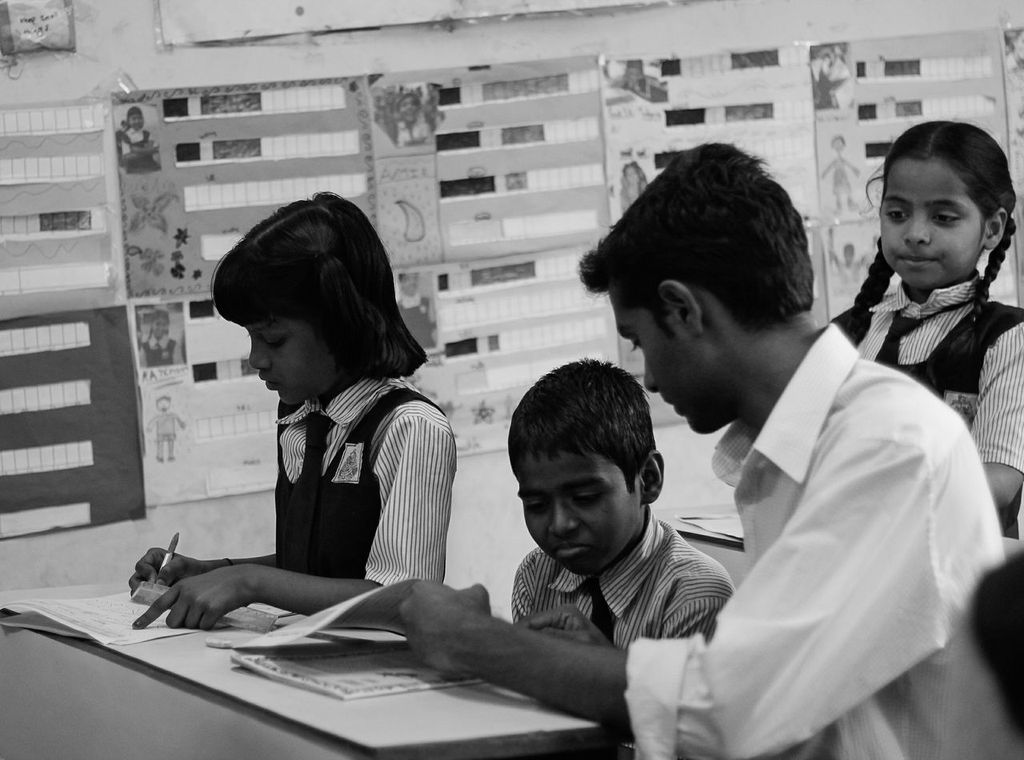
From a half-interested Engineering student to a passionate teacher and an educator on a mission – this is the transformation that choosing Teach for India has wrought on Prasid. The change in this former classmate of mine parallels the transformation of many of Prasid’s students at Varsha Nagar School in Mumbai. As a regular visitor at the school, I felt that this was one story worth bringing to my readers.

“I had finished my MBA, and could get a well-paying corporate job. But why take the well-trodden path? Why not take up something that would give me the opportunity to make a real difference?” Prasid’s words today, as he explains his reason for joining TFI, strike at the core of those of us who sweat it out climbing the corporate ladder.

Who's the teacher?!

Who’s the teacher?!

From the beginning, the 31 students of grade 3 staked claim to Prasid’s life, which revolved entirely around lesson plans, field trips, assessment tests and fundraising. Between teaching his “kids” to independently read the unabridged Charlie and the Chocolate Factory and getting them to understand Pythagoras Theorem, between taking them to watch other TFI children perform The Wizard of Oz and playing badminton in the school hall, two years went by almost too soon. Looking back, Prasid feels a mix of nostalgia, satisfaction and the urge to do more.

I ask Prasid for experiences that stand out in his mind, and he tells me there are simply too many of them. He narrates the story of Priti who has now attained international grade 6 in English comprehension and won an elocution competition among eight schools. Not an insignificant achievement for someone who didn’t know any of the subjects, often resorted to copying in class, and used to be beaten at home.

Atul today stands out by his brightness, and is the wittiest kid in class. As a child who was severely ill-treated at home, he initially came across as disengaged in class. However, when he was given the freedom to be himself, things changed, seemingly miraculously to someone not aware of what Prasid did. Shifa was someone with whom Prasid nearly “lost hope after six months” of efforts. She came from a broken family, and her mother was illiterate to the level of not being able to sign a document. Today, Shifa is a bright student, creative and talented in the arts.

We are friends

We are friends!

These stories illustrate Prasid’s firm belief that teaching is much more than disseminating content, it involves giving attention and love, and truly caring for the children in the formative years of their lives. Which means convincing parents of a girl who dropped out midway to get her back in school, periodically visiting the homes of the children, and getting buy-in from other teachers. In short, keeping hopes high always. Which wasn’t as difficult as it sounds. “There was never a need for a holiday because my work itself was so rewarding and satisfying,” says Prasid, “Teaching never felt like a chore that I needed a break from.”

The kids will miss Prasid bhaiya and he will miss them as well, when another TFI teacher takes over the class this academic year. But then, the change that took place in all 32 lives will have its impact forever. As Prasid now looks forward to managing two schools started by a corporate, let’s wish him and his counterparts at TFI all the best, in their aim to transform India’s education sector, student by student, school by school.

Bad boys, baddy boys!

Bad boys, baddy boys!

Want to know more about what Prasid has done? Check out the Facebook page here. Have something to say to Prasid? He can be reached at prasid@gmail.com and @prasids

The Extraordinary Lives of Ordinary People

1. The Lady to Libya

“After 6 months, I will get a family visa, I can bring my children also…” She is a nondescript woman in salwar-kameez on her way to Delhi. It’s her story that merits mention. She is headed to Libya, as a nurse in a government hospital. The agency that arranged for her job and visa will pick her up in Delhi. “There are six of us from Kerala, some others from other places. The important thing is to somehow get through the first six months. After that I can bring my family.” Her husband and two children, aged three and one-and-a-half, will manage on their own till then.

“I have to go there and learn Arabi. Don’t know what the food will be like. But what bothers me is how the children will live without me.” Her soft eyes fill up in a moment, but then the tears go back in.

2. The Serious Young Lad

He sits clutching his bag, trying to be casual, preoccupied with something. “There was a death in the family – illness and old age, so nothing unexpected, but the date was unexpected. So I had been running around a lot for the arrangements.”

He has spent six years in the same company, a bank, after graduating with a degree in Math. He likes his life – a 9-5 job, some football, some volunteering – he is glad that he has a life outside work. “My job is changing now, I have to get sales and not just make sure that things are running smoothly.” He is with a group of management graduates now, who have experience in other banks. “Those guys are paid more simply because they have an MBA. What do they do differently?”

3. The Studious Cabin Attendant

She is studying for an exam on flight safety. As a cabin attendant, she has to give an exam every six months. The tests are more than academic. “We have to watch our weight – we can’t be overweight. We can’t be underweight either, because then we might fall ill. They give us time to come to the right weight, so it’s ok. It’s difficult when you eat food like this all the time,” she says, pointing to the sandwich.

The job pays well, but “the glamor is not as high as it used to be.” It is hard work as well, with 25-30 flights a week on average. “After five years on the job, you are not allowed to be a court witness. Because when you take so many flights, you tend to lose your memory. Your memory becomes unreliable.”

4. The Loving (?) Mother

The mother, the 6-year-old son and the 8-year-old daughter have all got middle seats. The children have settled down nicely in their seats, but the mother is restless. “Do you mind shifting? My daughter is very uncomfortable sitting alone. She wants to sit with me.”

The son stares at the mother across the aisle, with an uncomprehending look. The daughter turns back from where she is sitting with an open paperback novel – her discomfiture arises from the loud voice of her mother and the embarrassing topic of conversation. She wishes her mother wouldn’t make a scene, it’s only a couple of hours after all. But sometimes mothers miss their children more than the other way round and possessively try to allay imaginary worries.

5. The Entrepreneur’s Daughter

She is like any other college student, living with friends in a hostel. But her sights are set high. “I want to do an MBA abroad and then return to work in the family business.” Her father built up a pharmaceuticals company, and the responsibility to run the business will soon be on her shoulders.

The expectations are high – the father has won an Ernst and Young Entrepreneur Award for his work. The Award that let her spend a week at Stanford learning about running the family business. And made her more confident of her decision to learn business right after undergraduate studies, unlike many of her classmates. The father is an entrepreneur, but the daughter has to be a manager.

P.S.: All the above are snippets of conversations with fellow travellers on flights…

-~-

Stark Reality, Simply Narrated – a Review of ‘Behind the Beautiful Forevers’

There are some books which you know are good, but you also know that they are so tangential to what you do on a day-to-day basis that unless you set apart solid time, you won’t get around to reading them. And so you avoid thinking about them, and even when you see such a book lying on a colleague’s table, the bookworm in you starves itself by ignoring the book. Such are the woes of those of us who go to work every day.

And yet, sometimes, there comes a day when the book returns to you, and you end up reading it in spite of yourself. And you realize that it was worth it. That’s how Behind the Beautiful Forevers turned out to be. <Warning: multiple plot spoilers ahead.>

Pulitzer Prize winner Katherine Boo’s BTBF is the real story of a few families and street children living in Annawadi, a nondescript slum near the Mumbai airport. Among them are ragpickers and slumlord-hopefuls, animal lovers and teachers. There are children grown too old too quickly by poverty, there are friends who know that to help someone is to invite disaster upon oneself and to share is to starve, and there are opportunists who know the multiple sources of money in an impoverished slum.

When a handicapped woman attempts suicide, only to regret it immediately, and then dies in hospital, her neighbours are arrested and incarcerated for murder. The subsequent trials take their toll on the Husain family not only because of the loss of income of days spent in jails, but also because of the uncertainty of whether the father, son and daughter would ever be released from prison. The family takes an impossibly bold and apparently reckless stance of not paying anyone despite repeated offers from various quarters to “help” them be declared innocent of a crime they did not commit.

When Abdul muses that Kasab, one of the perpetrators of the terrorist attack at the Taj in South Mumbai, has at least the saving grace of being tried for a crime he did commit, it reeks of resignation at a political and judicial system so convoluted that it is effectively unable to determine innocence and guilt: the only color it recognizes is that of money, the only command it follows is that of power. When Abdul and his family are acquitted, seemingly more by chance than by design, there is no particular victory to be celebrated, only a permission to go on living that was nearly too late in coming.

BTBF also reminded me of a mildly unsettling realisation that I had been conscious of since I started travelling on work, coming into contact with staff at airports, hotels, taxis and offices: to be nice to such people is not an act of generosity on your part, it is a privilege granted to you. It is only the rich who can afford to be nice, to lavish money on tips, to pleasantly wait two more minutes as the room is readied, to smile at the housemaid. For the ragpickers who “earn to eat,” niceness is a luxury they can neither afford nor gain from. (If this sounds moralising, let me flatter myself that the years have made me wiser!)

For what is Boo’s first full-length book, BTBF is very well-written. What I liked best was the impeccable flow of the narrative that gives hardly a hint of the copious amounts of research and file-chasing behind the facts. Unlike the exclamatory tone adopted by many first time visitors to Mumbai and its slums, and unlike the patronising optimism of Slumdog Millionaire, BTBF possesses a clearheaded voice, unassuming but sympathetic, pragmatically limited in its sentimentality and hopefulness. After all, the lives of Akbar and Sunil and Asha and Manju are not going to change in a day. At the same time, this also makes the purpose of such a book unclear. Yes, it lays bare the stark reality of life in a slum next to the gleaming airport, but there is no call to action. Then again, who is to say what the right action is?

Despite being a work of non-fiction, BTBF also bears similarity to City of Joy, a novel by Dominique Lapierre on life in the underbelly of Kolkata in the 1970s. The book traces the lives of people as diverse as a rickshaw-puller, a Polish priest and an American doctor, all linked by their lives in Anand Nagar (the “city of joy”), a slum in Kolkata. Lapierre’s description of the rickshaw-puller Hasari Pal’s life left such an impression on the class nine student who read the book (yours truly) that she could never be at ease in the cycle-rickshaws of Gurgaon, years later. Indeed, during that stifling summer, the one-hour walk from office to home was preferable to the discomfort of seeing an invariably reed-thin man sweat for me. It tore my heart whenever he bargained to transport the three of us for an additional ten rupees on his own rickshaw, rather than let one of us take a second rickshaw. But I digress.

~*~

P.S.: I had meant this post to be only a review of BTBF, but felt that it had to do justice to how I ended up reading a book I had deliberately kept off my regrettably short reading list. Many thanks to the protagonist of the first two paragraphs.

‘A Passage to India’ and Other Books

‘A Passage to India’ is a novel set during the later days of British rule in India, and I had expected it to be yet another, perhaps a little less clichéd, description of Indians and the Indian way of life as seen by an Englishman writing from his country or at most, writing based on his visits to India. But I was in for a pleasant surprise. E. M. Forster describes, in a nuanced and sensitive manner, how Indians and Englishmen got along with and sometimes did not get along with each other, as they inevitably came into contact.

The plot  in ‘A Passage to India’ is far from vast. It can easily fit into a short story – Aziz, a widowed Muslim doctor, offers to take Adela Quested and her future mother-in-law Mrs. Moore on a trip to visit the well-known Marabar caves in Chandrapore. Inside one of the dark caves, Adela imagines that someone tried to attack her and assumes without doubt that her invisible attacker was Aziz. He is arrested and tried in court, but before the trial is over, Adela realizes that she was mistaken and withdraws her complaint. Yet, the damage is done and many lives have been affected irrevocably.

The author leaves unsaid, but makes amply clear, that while these are important events in the lives of a few Indians and Englishmen, they illustrate merely another instance of the impossibility of true and trusting relationships between two groups widely separated by not just geographical and cultural barriers, but also the more divisive chasm that distances the ruler from the ruled.

For instance, open-minded Englishmen such as Mr. Fielding (whom Aziz gradually starts to think of as simply Fielding) might become friendly with Indians, but their English wives can never really mentally get past the distance. For all their determination to see the “real India” and their friendly disposition towards Aziz, Adela and Mrs. Moore are never truly at home in India.

Indians in the book are not blameless either, for they hold stereotyped views of the Englishmen and English women. With the caveat that what comes out in the book is perhaps the English stereotype of what the Indian stereotype of the English is. (The book is nowhere as convoluted as the sentence you just read, so do not let my analysis dissuade you from reading it.) In short, ‘A Passage to India’ is an eminently readable story, one of the rare books that make me wish I had read them earlier.

What I like best about ‘A Passage to India’ is the way Forster narrates and implies, but never brings himself into the story. In comparison to the two other books that I happened to read recently, ‘A Case of Exploding Mangoes’ (a historical thriller based on the death of Pakistani President General Zia ul-Haq) and ‘The House of Blue Mangoes’ (a mostly lifeless account of the lives of three generations of a family based in South India), ‘A Passage to India’ is a refreshing piece of work. It is as a novel should be – the characters are so important to you that at least for the period you are with them, you fancy that you care for what happens in their lives, you want to know how things turn out for them. In this respect, the book reminded me of ‘The Mandelbaum Gate’ by Muriel Spark.

The book that I am currently reading is just as powerful. ‘The Finkler Question’ (Howard Jacobson’s Man Booker Prize winner that is witty and sympathetic in equal measure) brings up severe issues with a gravity that is as unbelievable as it is real. Because that’s often how life is, a curious mix of the comical and serious. Julian Treslove is just another guy next door till he is mugged one night on the way home, and a phrase uttered by his assailant (a phrase which he isn’t even sure he heard right) changes his outlook to life. From the outside, there is no break in the flow of his life, but mentally he is a changed man. Not impossible, I suppose.

-~-

P.S.: With all this mention of books, it is very natural to wonder whether this consultant (yours truly) has been “on the beach” far too long. But the more pertinent question is whether this consultant has been on far too many flights…