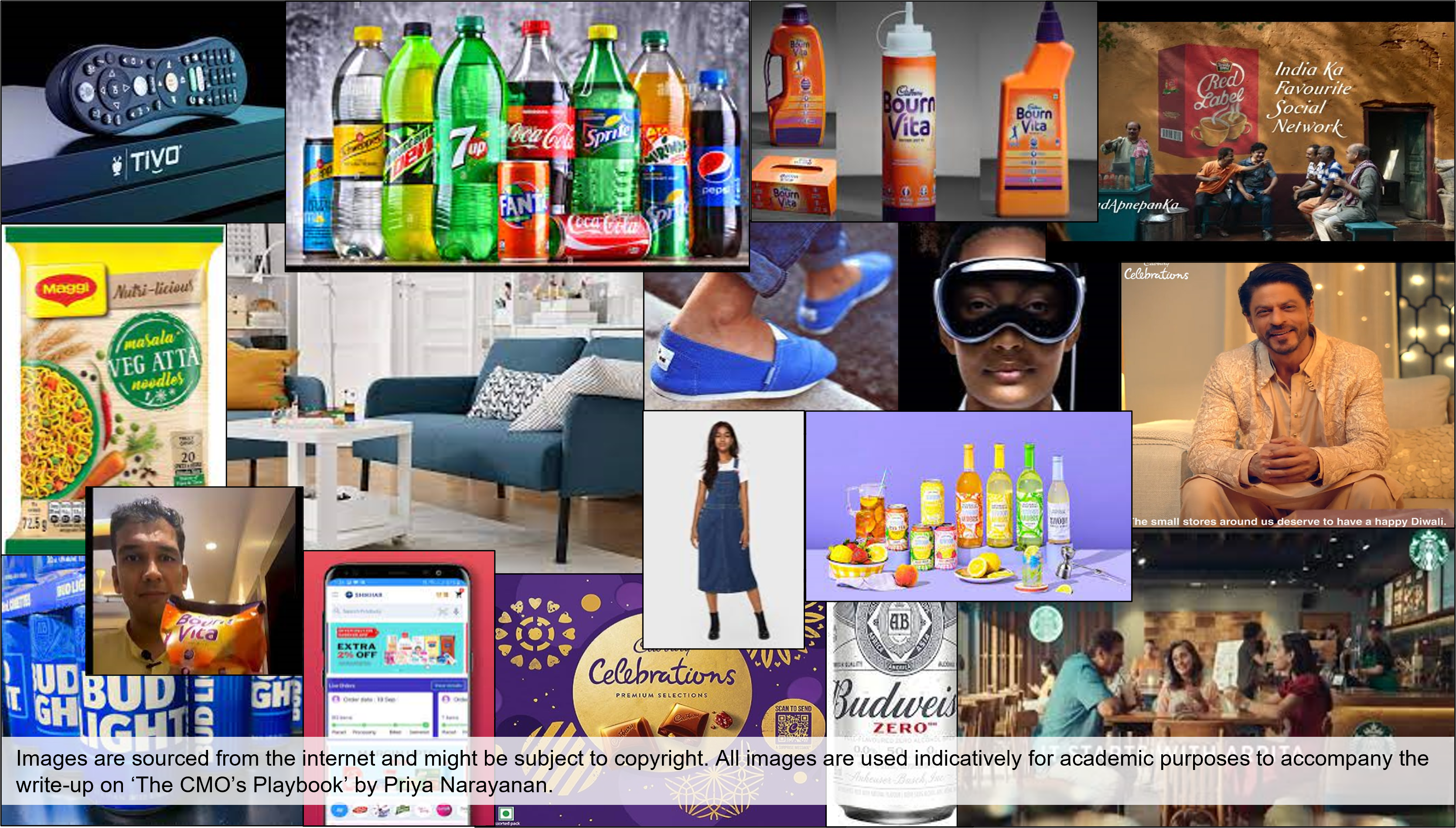
The CMO’s Playbook – This Year’s Collage

Whenever the small-group discussions in the classroom get noisy, it means one of two things: the students are so interested that they forget they are in a classroom, or there are movies playing in laptops, hidden by the huddle of heads. When these discussions are about marketing strategy in The CMO’s Playbook, it’s the former.

Sometimes we teachers are happy when the class is loud.

*

Here is a (hand-made) collage from the cases and contexts that we discussed in the course last year (2023 Jun-Aug). Can you identify all the companies and situations?!

*

Here are a few answers.

Coca Cola in India: A product portfolio worth boasting about, but who wants sugar and fizz now? This was (and is, and will continue to be) the dilemma of what is perhaps the world’s best built brand (for a brand backed by hardly any product worth its price). The new year spells interesting times for Coca Cola and more so for Coca Cola India with cannibals and competitors galore.

Continue reading

“India’s social network” is tea. The question is, which tea?!

First published July 2, 2023. Updated Oct 31, 2023 with a) an edited version of the ad shared by Red Label (following my article?!), and b) link to relevant research article.

© Priya Narayanan, Assistant Professor of Marketing, IIM Kozhikode. Views are personal.

A recent advertisement projects the humble tea as “India’s social network”. The ad is probably trending by this time, and worth at least one watch. The customer insight is spot-on. The video portrays various ways in which tea takes the form of friend requests, likes, shares, trends, stories, and so on in India, becoming a social network in itself. Engrossed as we are in the narrative, we forget that this is a brand’s commercial. Finally, though, the very last shot tells us that the ad is from Brooke Bond Red Label.

Screen shot from the “India’s social network” ad (watch the full ad here)

Well, as I watched the ad play, my thoughts centred on the cup of Kanan Devan (Tata Tea) tea that I usually drink in the morning and evening… steaming tea in a steel tumbler… the quantity never enough but I never make more… I am happiest when that tea is fully foamy at the top… and when I blow on it a teeny bit, the foam makes space for the beautiful brown color beneath… if the color is the right shade, the tea will be the right taste… oh yes, the tea packet at home is nearly finished and I need to buy another of the green packets soon…

Continue reading

Next Diwali, Let’s Avoid the Condescension of Doing Good? [Financial Express]

© Priya Narayanan, Assistant Professor of Marketing, IIM Kozhikode. Views are personal.

This article was first published on May 27, 2022 in the Financial Express and is available here on the publisher’s website. In this article, I present my take on the “condescension of doing good” that is visible in recent Diwali advertising, and urge marketers to put human values first.

The version below includes links to the relevant advertisements that I discuss.

It was Cadbury that hit upon the idea of brands doing good during Diwali in a seriously big way – the 2020 ad from Cadbury Celebrations showed how small local stores that were hit by the pandemic could be brought into the customer’s consideration set through geography-based hyper-personalization. “This is not just a Cadbury ad,” they said, and so we believed: the ad nudged us towards local stores. Thus it was that in the midst of the pandemic, Cadbury found a way to do good and be good, and yet gain marketing momentum.

But the next year, as the prestige factor was upped, Shah Rukh Khan’s charisma was deemed essential to do the same job for a similar ad by Cadbury. In this ad, Shah Rukh Khan names local stores in his voiceover and this, again, was powered by technology. It wasn’t too bad, except the realization that our purchases of Celebrations were funding the expense incurred in engaging the celebrity actor.

But this year? With its #ShopsForShopless ad of 2022, Cadbury has, despite its best intentions, fallen prey to “purpose”, the new catchword in marketing. Somebody (or worse, everybody) at Cadbury seems to have decided that for Celebrations to stand out, it had to be tagged with purpose. So, now that good old eating and gifting are not enough for Diwali, the Cadbury ad tells us to scan a QR code on the sweet box, help roadside hawkers set up virtual shops, and buy from such shops. For the kind of “help” that they received, the gratitude in the eyes of Damodar (not Damodarji?!) and his helper is nauseating in its excessiveness.

Continue reading

Me e Mia: An Introspection into Brand Love

Part I: The Customer’s Perspective

© Priya Narayanan, Assistant Professor at IIM Kozhikode. Views are personal.

The other day, I shared a thought on LinkedIn on the Mothers’ Day video of a jewelry brand. Mine wasn’t a well thought out analysis, it was simply a spontaneous reaction to the content of the video. Writing the post, however, made me wonder: why did I care so much? Why was I so strongly unhappy with the ad? (The tone implied in “golden shoulders” surprises me now!)

Well, eight years ago, I wrote about this very same brand, on wearing the Tanishq Mia mantle of confidence.

Rereading that led to some introspection, which then led to the conclusion: I am in love. Yes, I don’t wear much gold jewelry but I love the brand that is Tanishq. Naturally, I felt the possessive anger that only love can lead to when Tanishq made a statement I didn’t feel good about or agree with. So says the marketer in me about the consumer in me. Me e mia. Me and mine. Me and my brand.

Continue reading

Advertising in the Pandemic’s Reality

© Priya Narayanan, Assistant Professor of Marketing, IIM Kozhikode. Views are personal.

Advertisements have changed quite a bit to reflect the reality of our daily struggle against covid-19. They no longer casually encourage consumers to splurge thoughtlessly: more and more advertisements are giving us reasons to buy. And more and more products are associating their reasons with the current situation. Handwashes, sanitizers, and Disney+Byju’s aside, there are a few interesting ads. Consider a few examples.

Recently, I was told that Lakme’s lip products have taken a hit, at least as evident from their product display on e-commerce sites. Natural enough, I thought, although I was unable to verify the news. After all, when lips are hidden by masks, the only time you can show off your lipstick is when you are eating (which happens only at home) or when you are in front of a webcam with a virtual audience. Well, that has not deterred either Lakme or Garnier. The same pandemic that has reduced consumption of lipstick (literally too!) has deterred visits to beauty parlors, implying that consumers need a substitute. Lo and behold, here is the “sheet mask” that gives the effect of a parlor-like “facial” in fifteen minutes! See a sample below, from the cosmetics seller Nykaa.

Continue reading

Google Duo’s New Campaign in India – To What Purpose?

© Priya Narayanan, Assistant Professor of Marketing, IIM Kozhikode. Views are personal.

Saw an ad for Google Duo the other day, and this one is worth talking about. But probably not worth much more.

It shows the freshest couple in town – who else but actor Anushka Sharma and cricketer Virat Kohli! – at their admirable best. Even earlier, every young couple had wanted to be like them: rich, famous, good looking, and young forever. Now, in this video ad available on YouTube, we see the camaraderie between them as Anushka plays a prank on Virat.

Agreed, the laughing wife and the trusting-but-fooled husband are quite adorable. However, in a video calling market increasingly captured by Whatsapp – everyone uses Whatsapp messaging, and its video calling is seamless with messaging – it is not clear how developing a celebrity-based liking for its brand will help Duo.

Continue reading

The Changing Actors of Indian Television Advertising [Prize Winner]

This article was first published as a prize-winning entry in the Dec 2018 edition of the campus newsletter on marketing, Niche (Niche on Facebook here and on Twitter @iimaniche). I have added YouTube links to some old ads.

*

Some of the earliest Indian television ads have been by the soap brand Lifebuoy. Our parents, if not we, would recall how Lifebuoy entered the market as a long red bar of carbolic soap, often cut into two halves before being used, for that was an age of patent frugality. The bathing experience, with a bucket and mug, was not very similar to the shower in the tandurusti ad, but there you have it: advertising is more aspirational than realistic. How, then, has such advertising portrayed its actors?

First, the children. Who can forget the adorable girl and her sweet way of saying, “I love you, Rasna”? While Rasna might now be passé, the idea of presenting children in advertising, targeting either parents or children or both, is an incredibly winning strategy. Remember the boy beating up a puddle on the road in the Surf excel daag acche hai campaign? As all seasoned advertisers know (and many others suspect), the road to a mother’s heart (and her purse) lies through children.

Click here to continue reading.