Marketing Meets Technology – Bringing Marketing Practice to Academics

© Priya Narayanan, Assistant Professor of Marketing, IIM Kozhikode. Views are personal.

This article describes my new elective course that focuses on how Technology has impacted Marketing practice, across four major dimensions: consumers, omnichannel marketing, martech, and marketing strategy. Besides discussing the use of caselets shared by two companies, the article lists a set of useful resources in this domain. Comments from participants of the course speak to its practical relevance and academic usefulness.

*

In May 2021, I decided to teach a PGP elective course The Digital Customer at IIMK. The idea was motivated by my sense – vague as it was – that the customer in the 2020s was no longer the customer of the 2010s when I did my MBA and PhD. We covered quite some ground, the students and I, but I was sure there was a lot more to my “sense” that things were changing rapidly.

I then offered a different elective Marketing to the Digital Customer in 2022, which, in hindsight, was even less satisfying in its ability to capture the goings-on in the market and in the field of marketing. Students probably guessed this, because the course found no takers.

In 2023, after much rework, the course reappeared to PGPs as Marketing Strategy for the Digital World. This course resonated with Executive PGP students, and with PGP students in 2024, as some of the course alumni who might be reading this post might agree. If you do, pls share in the comments!

But marketing strategy for the digital world was, after all, what every company was doing: adding a digital flavor to everything marketing. So what remained besides regular Marketing? What was it that was worth learning about from a student’s or manager’s point of view?

To me the answer was closer to a “reinvention” of marketing. That too, very likely a bottom-up reinvention, because technology had begun to touch each element of marketing and transform many of those. Marketing as traditionally understood and taught through the standard b-school perspective needed a relook. It was a bold and semi-substantiated view to take, but bottom-up changes necessitate top-down evolution in strategy. This, for sure, was worth studying!

And so, the course Marketing Meets Technology came into being. This is what Marketing had been doing for the last decade! I first wrote about the course on my blog in June last year as the course started taking shape. The very first innings of the course with over 80 participants from the executive MBA program was wrapped up late last month. The course consists of four modules:
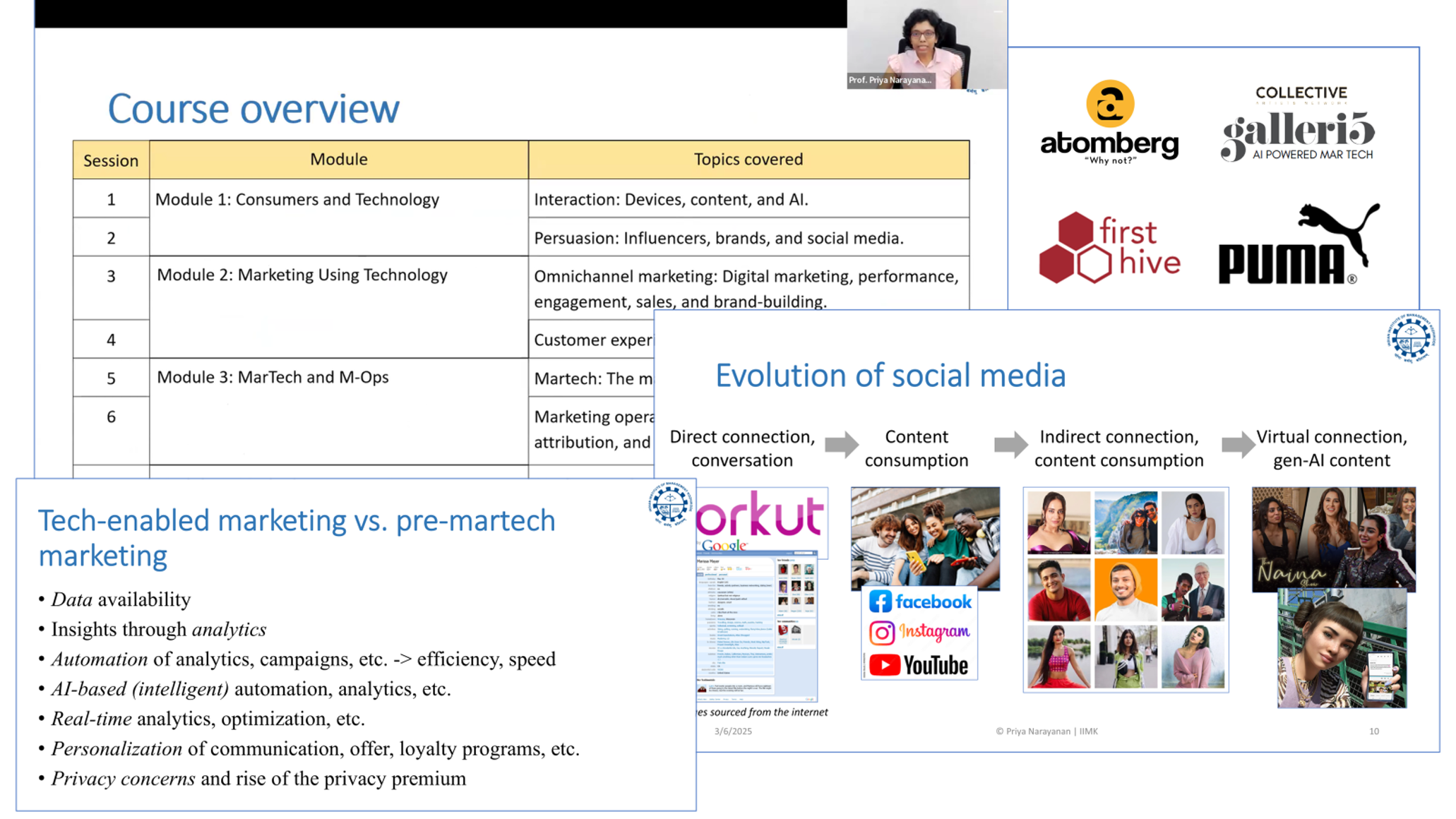
What we covered in the first innings of Marketing Meets Technology
Continue reading

Take Two: The Future of the Two-Year Full-Time MBA in India

© Priya Narayanan, Assistant Professor of Marketing, IIM Kozhikode. Views are personal.

This article was first published online on December 13, 2024 as a special feature in the IIM Ahmedabad alumni magazine WIMWIAN and is available here on IIMA’s website for the magazine. Note: I hold an MBA (the two-year full-time kind!) and a PhD, both from IIM Ahmedabad. The programs that I teach at IIM Kozhikode are listed at the end of the article.

*

Recent months have witnessed an emerging debate on the relevance of the two-year full-time MBA programmes across B-schools in India. With the rise in online and hybrid programmes boosted by the pandemic, and prospective students reconsidering spending two full years on academics, the flagship postgraduate programme at IIMs and other B-schools is under scrutiny.

To understand the issue, it is important to note that IIMs, especially the older IIMs, had historically been endowed with the mandate of training managers for the country. These institutes did so through rigorous academic programmes spanning a vast curriculum traversed over two years, and churned out general managers who could hold their own in any field.

The evolving MBA

Over the years, many things have changed but many things have held steady. Demand for the two-year full-time MBA (referred to as PGP, using legacy terminology) continues unabated: the most recent 2023 edition of the Common Admission Test (CAT) that originally provided admission to the IIMs but is now adopted by several other B-schools was written by 2.88 lakh candidates, an increase of 30% over the previous year. Clearly, the numbers attest to the popularity of the PGP.

Continue reading

The 10 best Marketing cases I have ever taught

As the new academic year rises on the horizon, I thought about the cases (in Marketing) that I have taught in past few years and listed the top ten. My best teaching experiences – taking into account the best learning experiences of my students – took place while teaching these cases.

The list is slightly inclined towards marketing strategy, and does not include the good old work-your-way-through-it numerical analysis cases as these are required but do become somewhat boring at times. I have listed only the interesting cases, which really connect with students and sometimes even divide the class!

Most of these cases can be taught across programs and years (perhaps a few are not suitable for the first-year basic marketing course, and many are unsuitable for undergraduate courses) with a little flexibility, creativity, and improvisation from the faculty. Then again, you can’t have a course of just these cases – these are best consumed as the laddus in a diet that otherwise consists of good old dal-chawal-roti-subzi, in my view.

Continue reading

The CMO’s Playbook – This Year’s Collage

Whenever the small-group discussions in the classroom get noisy, it means one of two things: the students are so interested that they forget they are in a classroom, or there are movies playing in laptops, hidden by the huddle of heads. When these discussions are about marketing strategy in The CMO’s Playbook, it’s the former.

Sometimes we teachers are happy when the class is loud.

*

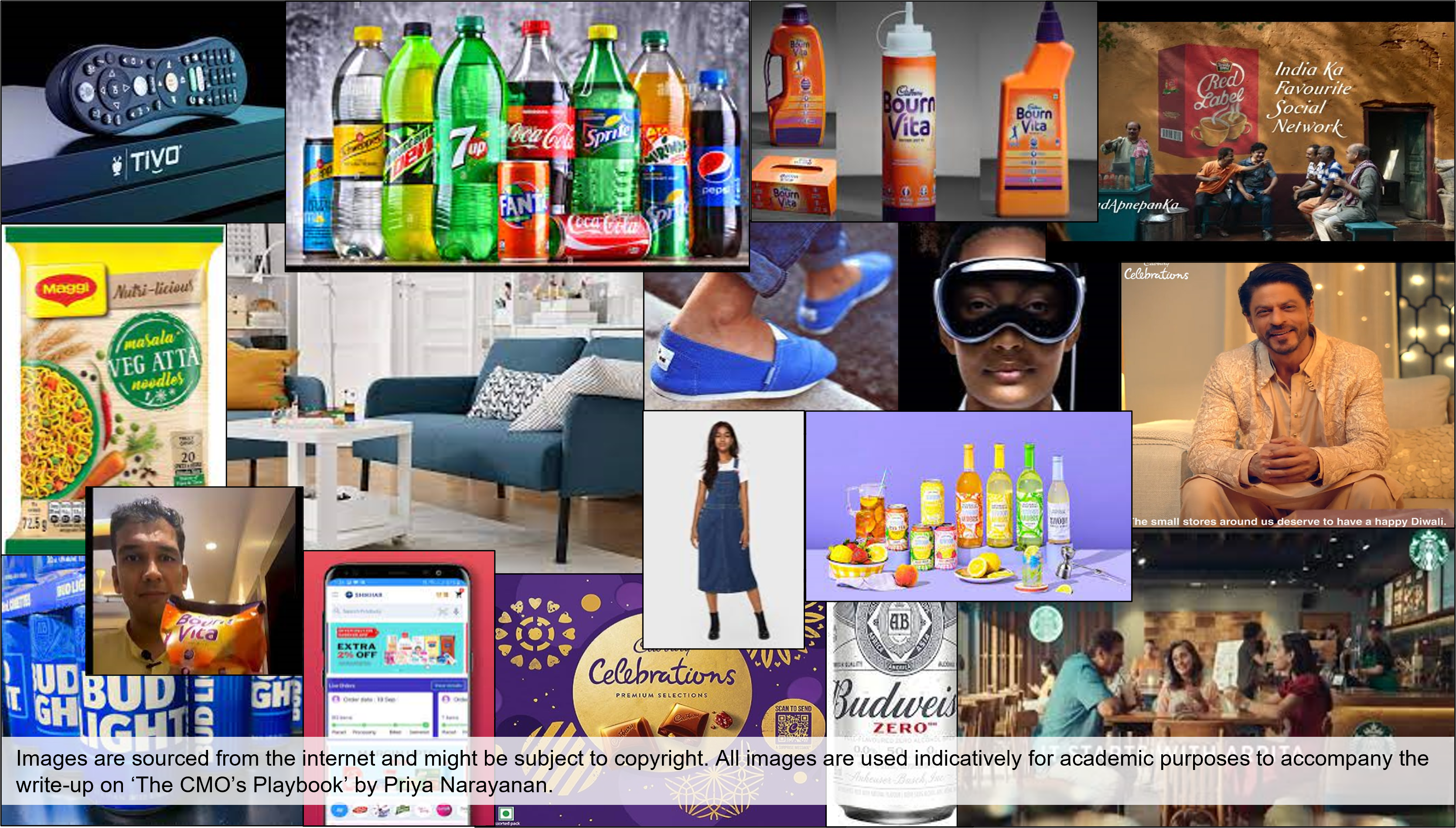
Here is a (hand-made) collage from the cases and contexts that we discussed in the course last year (2023 Jun-Aug). Can you identify all the companies and situations?!

*

Here are a few answers.

Coca Cola in India: A product portfolio worth boasting about, but who wants sugar and fizz now? This was (and is, and will continue to be) the dilemma of what is perhaps the world’s best built brand (for a brand backed by hardly any product worth its price). The new year spells interesting times for Coca Cola and more so for Coca Cola India with cannibals and competitors galore.

Continue reading